|
|
|
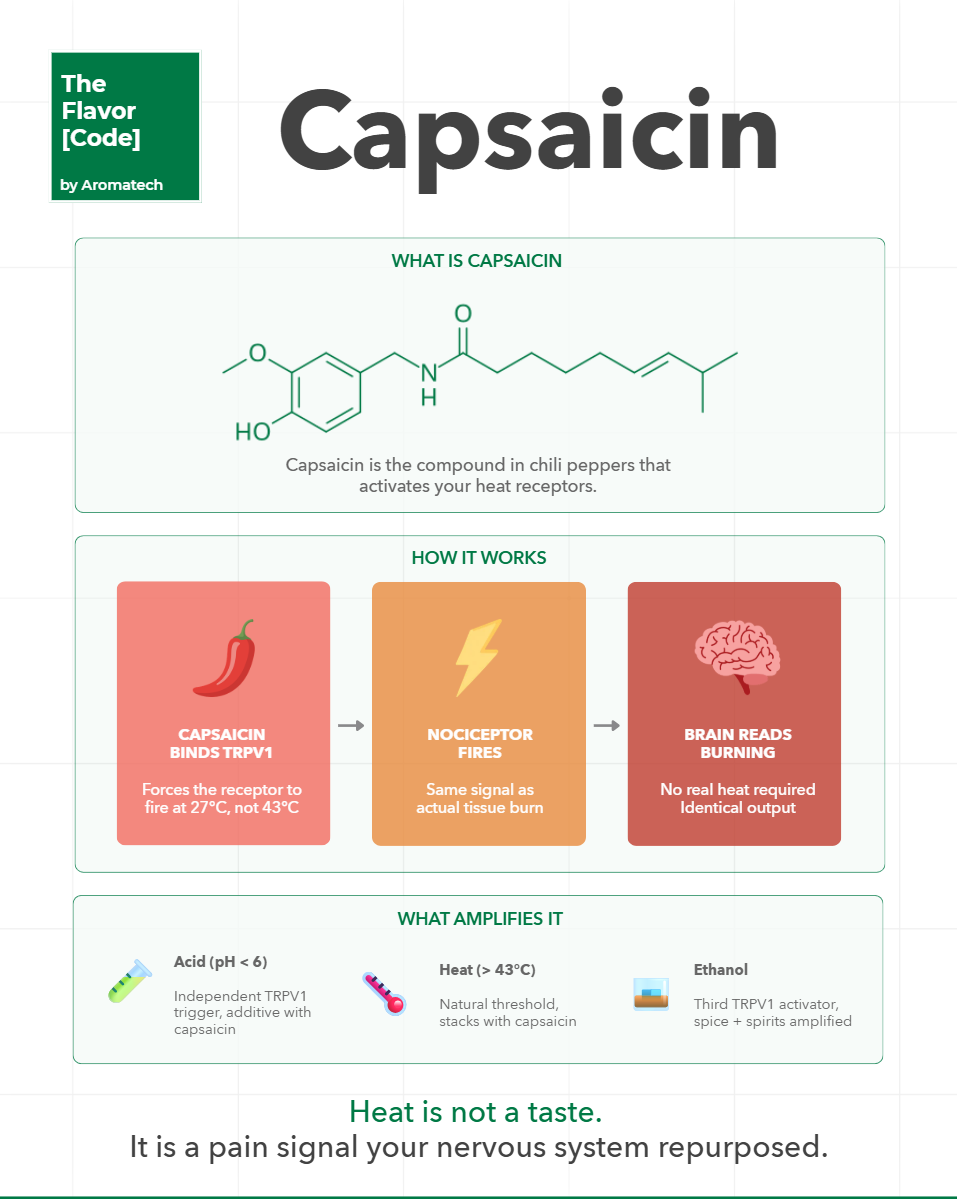
Heat is not a taste.
It is a pain signal your nervous system repurposed.
TRPV1: the Transient Receptor Potential Vanilloid 1 receptor, is a nociceptor.
Its biological job is to alert you when something is burning your tissue.
Under normal conditions, it fires above 43°C. Capsaicin does not create heat. It forces TRPV1 to fire at 27°C (room temperature).
Your brain receives the same signal either way and draws the same conclusion: something is burning.
Which means every heat formulation challenge is a neuroscience problem in disguise.
A few things that follow from this:
🔴 pH amplifies the signal.
TRPV1 is also activated by acidic conditions (below ~pH 6). Add citric acid to a capsaicin-containing formula and you have two independent stimuli hitting the same receptor. Perceived heat increases, even if the capsaicin level didn’t change.
🌶️ Capsaicinoid profile controls the temporal arc.
Capsaicin builds fast, fades relatively quickly. Dihydrocapsaicin (same receptor, different molecule) lingers. The ratio between them determines whether your product has attack heat or lingering heat. They are not interchangeable.
🔥 Ethanol does the same thing as acid.
Spirits plus spice equals amplified burn for the same physiological reason. Not a formulation accident. A certainty.
The practical consequence: if you’re calibrating heat in a reformulation and the pH or ethanol content shift, the heat shifts. Even if you didn’t touch the capsaicin.