|
|
|
Vanilla is the world’s second most expensive flavor ingredient, after saffron. Most people in food have never stopped to think about why.
It starts with a flower that blooms for a single morning, once a year, in Madagascar, where it grows roughly 80% of global supply. Every blossom is hand-pollinated with a thin wooden stick, one at a time. Nine months to mature. Four to six months of curing. That’s before anyone talks about weather.
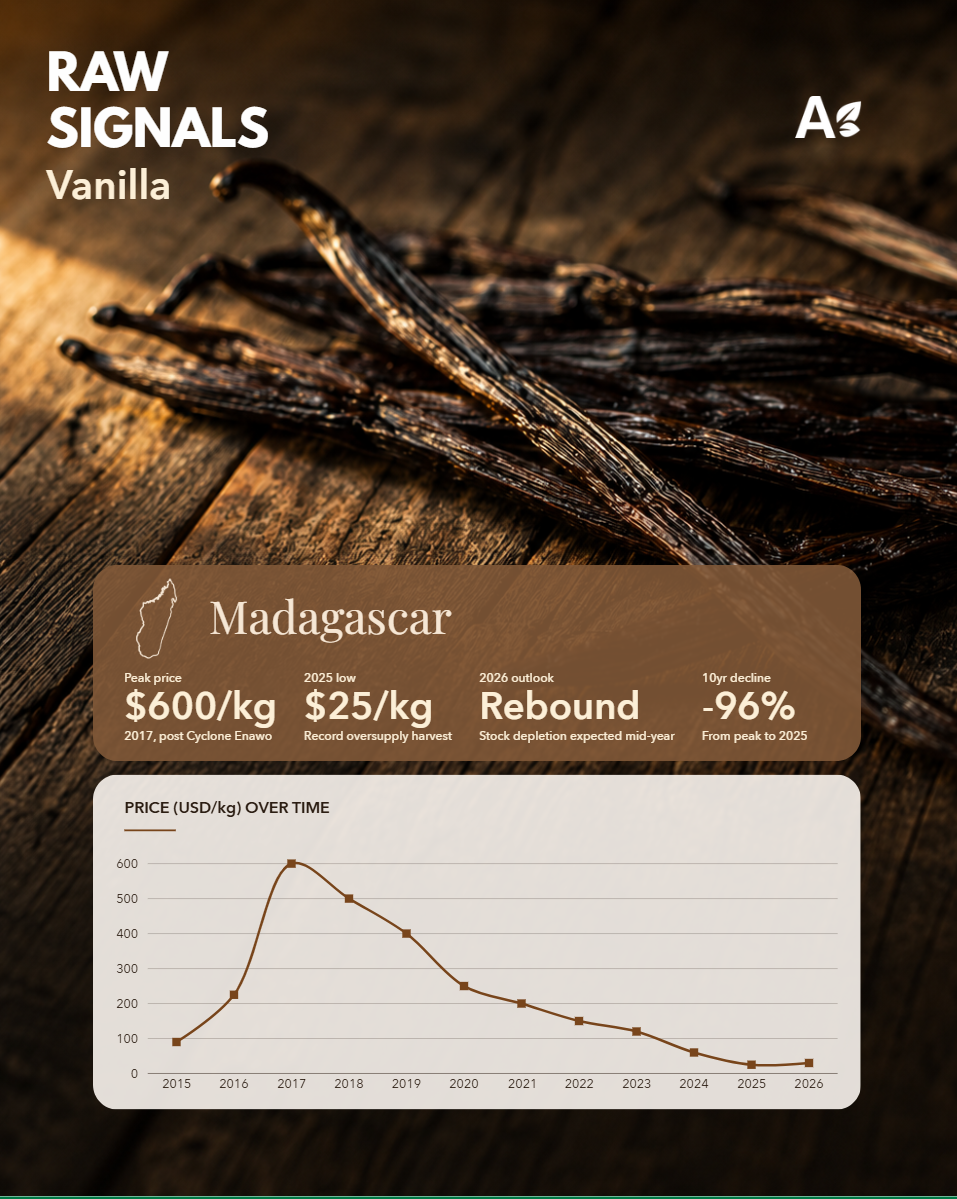
Cyclone Enawo hit in March 2017. Within weeks, spot prices jumped from ~$90/kg to over $600/kg. It took until 2019 before prices began softening, and only because the emergency plantings farmers made in response to the spike all came to harvest at once, flooding the market. By 2025, that same oversupply had pushed prices back down to ~$25/kg. A nearly 96% drop from peak.
That’s the rhythm of vanilla. Not months, decades. At least three major price shocks since the 1980s, each one a different combination of weather, speculation, and the structural fragility of a supply chain built on one island and one harvest window.
The challenge isn’t just cost. It’s predictability. Natural extract batches vary. Synthetic vanillin is more consistent but carries its own compromises. When the market spikes, the pressure to swap, dilute, or reformulate fast is real, and rarely produces better results.