|
|
|
“Natural Flavor.” It is one of the most common ingredients on the American food label, and almost nobody, including plenty of people who work in food, can tell you what it actually means.
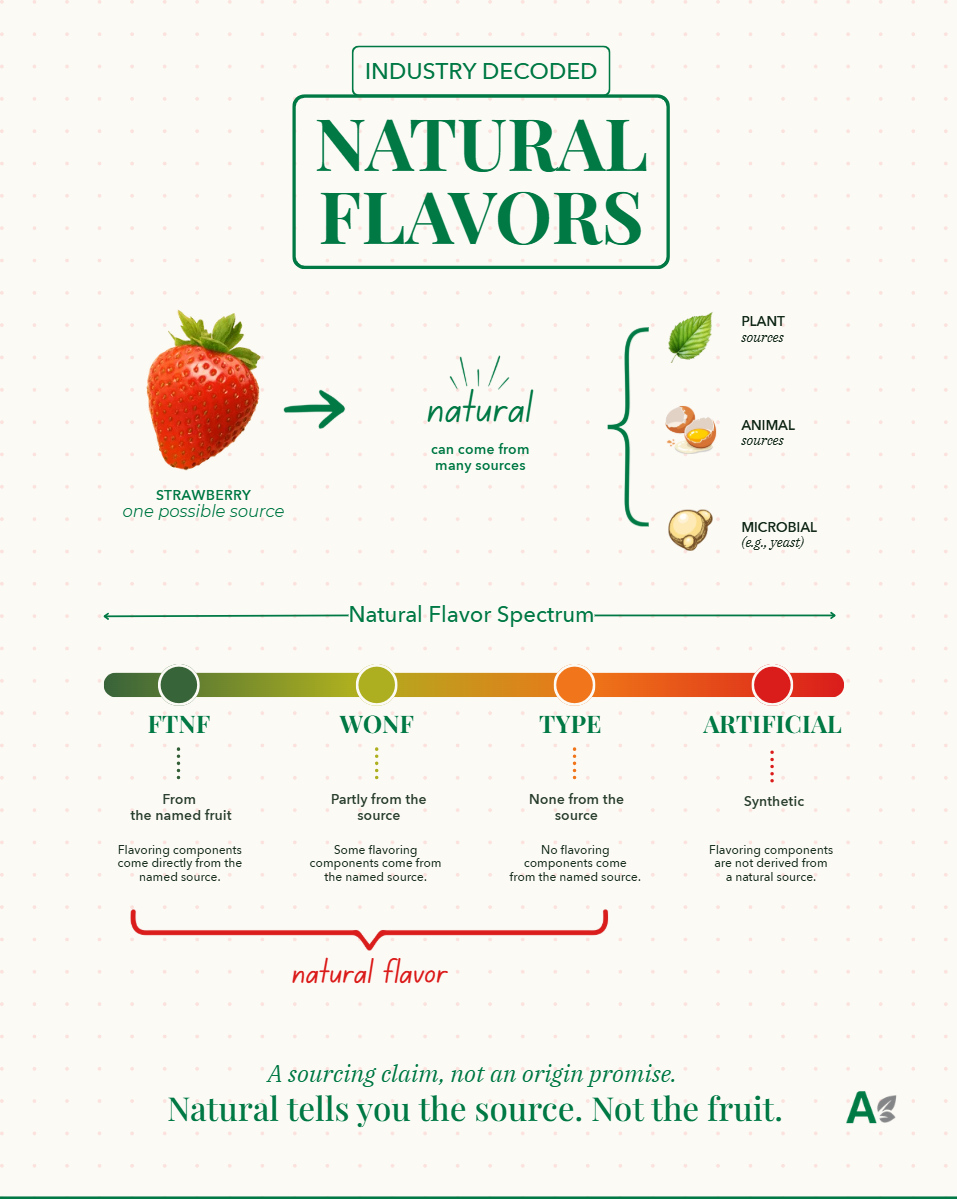
In the United States, a natural flavor is defined by the FDA (21 CFR 101.22) as a substance whose function is flavor, derived from a biological source: a spice, fruit, vegetable, herb, bark, bud, root, leaf, edible yeast, meat, seafood, poultry, egg, or dairy product, obtained by physical, enzymatic, or traditional processes like distillation, extraction, roasting, or fermentation.
Read that again, because the surprise is how broad it is. “Natural” says nothing about the named food on the front of the pack. A natural strawberry flavor does not have to come from strawberries. It has to come from a natural source and taste like strawberry.
🏷️ On the sourcing spectrum, natural flavor is the wide umbrella that sits above the more specific claims. FTNF (From the Named Fruit) means it all comes from the fruit on the label. WONF (With Other Natural Flavors) means partly. Type means none of it came from the named food, but every component is still natural in origin. And plain “natural flavor” on a label can land anywhere on that range.
Why is the category this broad? Cost, supply, and consistency. Sourcing enough real vanilla, strawberry, or raspberry to flavor global production is often impossible or wildly expensive, and harvests swing year to year. Natural flavor lets a developer hit a target profile, from natural building blocks, at a price and a consistency the product can actually live with.
So, if you should remember one thing: “natural” is a sourcing statement, not a quality or origin one. If provenance matters for your brief, the words to specify are FTNF, WONF, or Type, not just natural. If cost and label-friendliness lead, natural flavor is the tool built for exactly that.