|
|
|
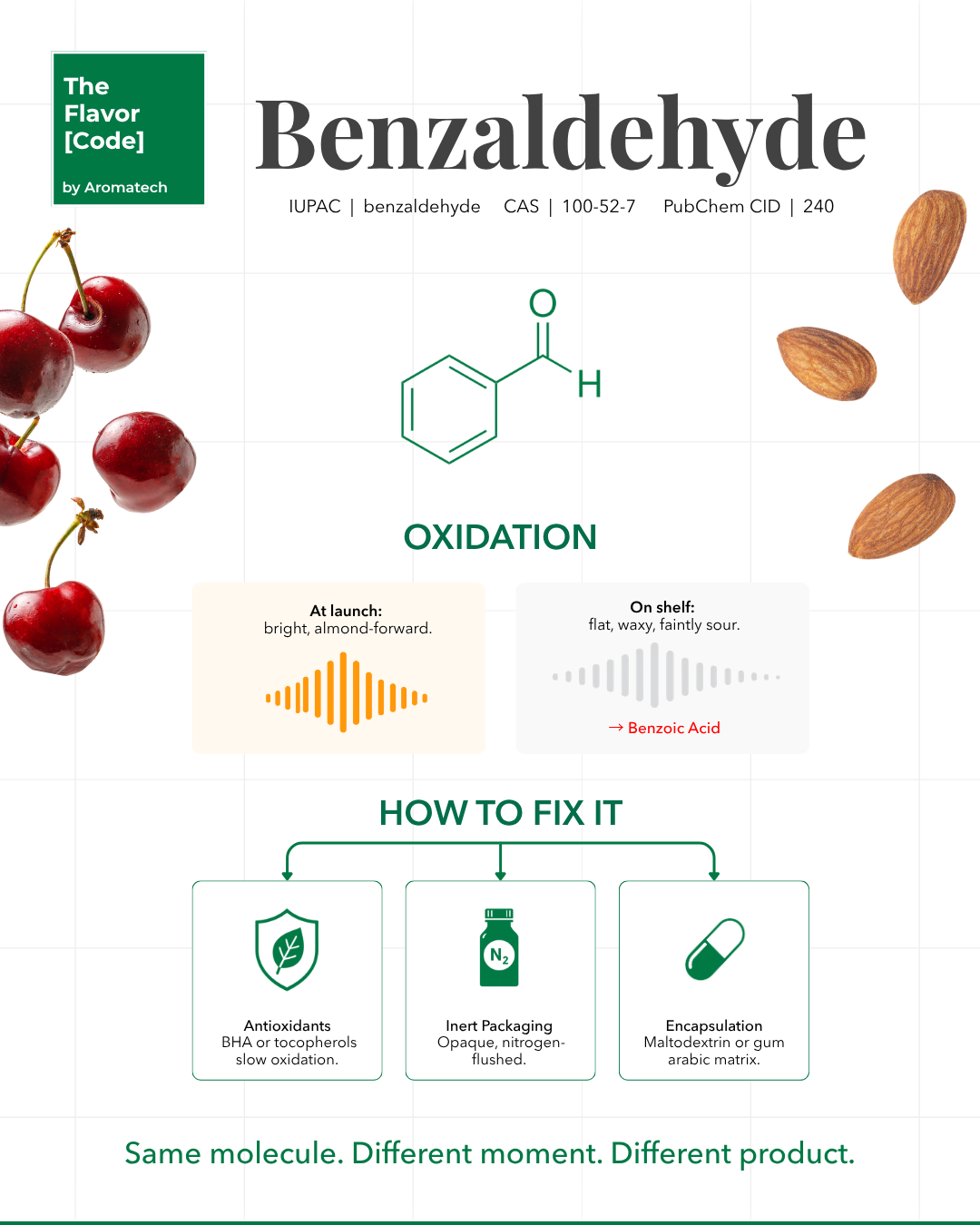
That almond flavor in your marzipan bar has probably never touched an almond.
Most commercial almond flavoring is either synthesized from toluene or pulled from cassia bark oil, not from almonds themselves. And there’s a real reason for that detour. In bitter almonds and stone fruit pits, benzaldehyde sits locked inside a bigger molecule called amygdalin. A group of enzymes collectively called emulsin cracks it open and releases three things: glucose, benzaldehyde, and hydrogen cyanide. Same reaction, opposite reputations riding on the same bond.
So flavor houses source it another way, and formulators still aren’t fully in the clear. Once isolated, benzaldehyde is chemically restless. Sitting in air and light inside a finished product, it slowly oxidizes into benzoic acid, and the bright almond top note turns flat, waxy, faintly sour. It’s why an almond extract that smelled perfect at launch can taste off a few months later on shelf. The fix is upstream: an antioxidant system (tocopherols or BHA), opaque and nitrogen-flushed packaging, or encapsulating the molecule in a maltodextrin or gum arabic matrix so oxygen never gets a direct line to it.