|
|
|
Mint gum leaves your mouth at body temperature, yet it feels like breathing winter air.
The sensor behind that is TRPM8, a cold receptor on nerve endings in the mouth and skin. In the study that identified it, the cloned channel started firing below about 25.8°C (McKemy et al., Nature, 2002). Menthol opens the same channel at body temperature, so the brain reports cold that is not there.
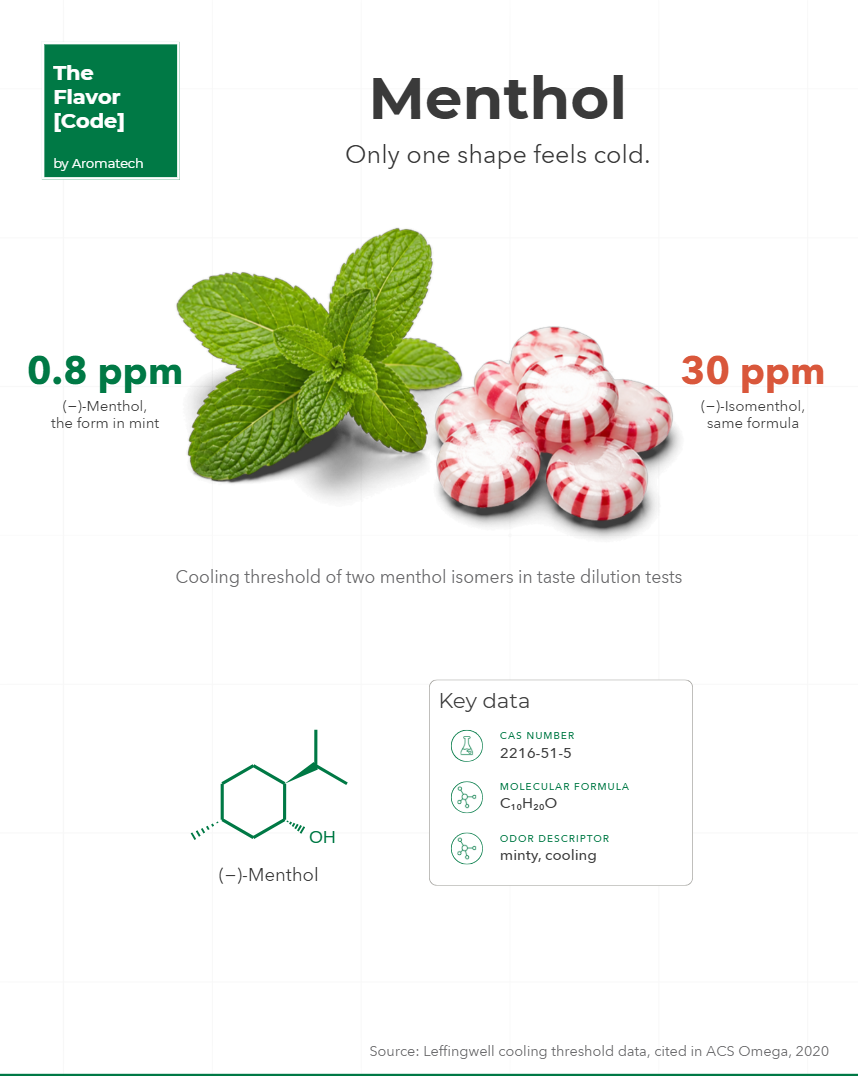
Menthol has three chiral centers and eight stereoisomers, and they do not cool equally. (−)-Menthol, the form peppermint makes, has a cooling threshold of 0.8 ppm in taste dilution tests.
(−)-Isomenthol has the same atoms (C10H20O) in a different 3D shape and needs 30 ppm before anyone feels cool. Synthetic racemic menthol is half (+)-menthol, which smells mustier and cools less.
Cough drops, mint gum and winter peppermint drinks all lean on the same left handed molecule. A spec sheet that only says “menthol” leaves the isomer to the supplier, and a lot that reads close to zero on a polarimeter is the racemate.
Write (−)-menthol (l-menthol, CAS 2216-51-5, optical rotation near −50°) into the spec.
Explore our flavor catalogue: https://aromatech-portfolio.vercel.app/index.html