|
|
|
Basmati rice and fresh bread don’t just smell similar. They share the same molecule.
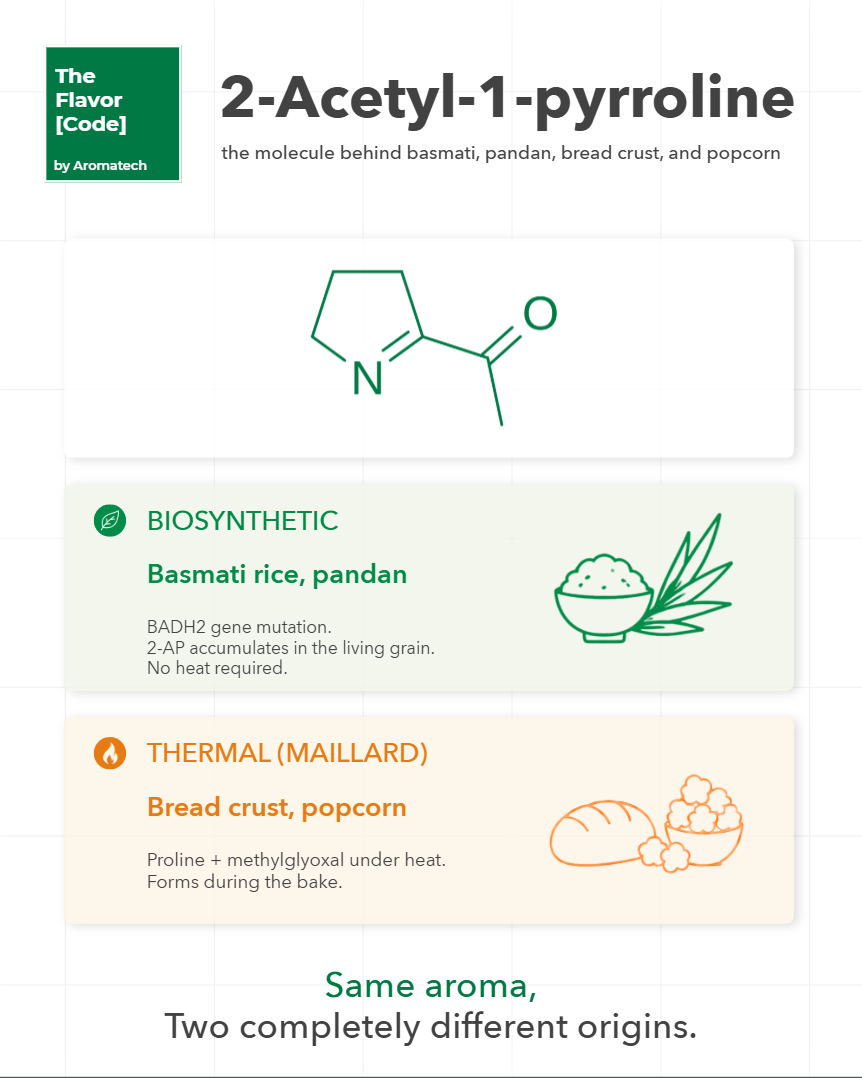
2-Acetyl-1-pyrroline.
One compound behind basmati, jasmine rice, pandan, popcorn, and bread crust. Detection threshold: 0.06 parts per billion.
The formation pathway is completely different depending on where you find it.
🍚 In aromatic rice, 2-AP is biosynthetic. A mutation in the BADH2 gene disrupts normal proline metabolism, causing it to accumulate in the living grain before any heat is applied.
🍞 In bread and popcorn, it’s Maillard. Proline reacts with methylglyoxal under heat. The molecule forms during the bake.
Same sensory outcome. Two unrelated biological origins.
The bench problem is stability. 2-AP is highly volatile, boiling below 100°C, and oxidizes in aqueous systems within weeks. At 0.06 ppb threshold, small losses are perceptible well before your panel flags anything formally.
🌾 Cyclodextrin inclusion complexes are the most validated protection route for baked applications, but they shift release timing in beverages and are not always clean-label compatible.
Building a pandan or basmati note without protecting 2-AP through the process is formulating for the bench sample. Not the finished product.