|
|
|
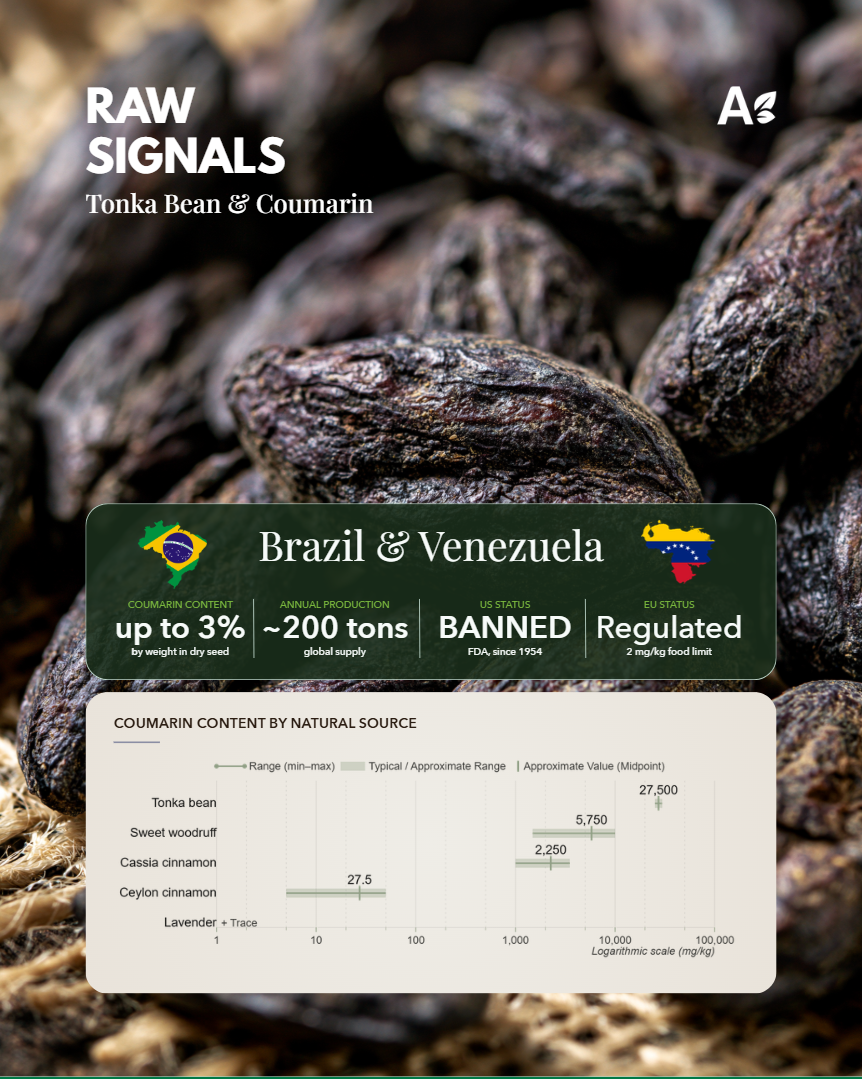
Tonka bean has been banned as a food ingredient in the United States since 1954.
Not restricted. Not pending review. Banned.
Meanwhile, in France, pastry chefs grate it over desserts the way we use vanilla. That gap almost never gets discussed, and it probably should.
Dipteryx odorata is an Amazonian tree native to the river basins of Brazil and Venezuela. Its wrinkled dark brown seed carries up to 3% coumarin by dry weight.
Coumarin is what gives fresh-cut hay its characteristic scent, and what makes tonka smell unmistakably like warm vanilla laced with almond and tobacco, a profile that has spent decades as the backbone of luxury patisserie in Europe and a ghost ingredient in global fragrance.
The FDA’s problem is the liver. Rat studies in 1954 showed coumarin to be hepatotoxic at high doses, and that was enough. It went onto the prohibited additives list (21 CFR 189.130) and has stayed there ever since.
What’s rarely mentioned is that the science has aged poorly. Rats metabolize coumarin into a reactive 3,4-epoxide intermediate far more efficiently than humans do. In humans, the dominant pathway produces 7-hydroxycoumarin, a water-soluble metabolite that clears quickly. EFSA reviewed the full evidence in 2004, concluded coumarin is safe at dietary exposure levels, set a TDI of 0.1 mg/kg body weight per day, and the EU regulated rather than banned. Two entirely different markets, built around the same seed.
Global production sits under 300 tons annually. Vanilla runs 4,000-5,000 tons per year. Tonka is a rounding error in volume, but effective use rates are low and most demand comes from fragrance, not food, meaning food buyers are secondary customers competing against a more stable industry.
For US formulators, the ban means working around an entire sensory register. The warm, rounded space between vanilla, almond, and hay has no clean substitute. Some houses approximate it with fenugreek, sweet woodruff, or botanical blends. None land quite the same way.
Updating the 1954 ban would require a formal GRAS petition. Nobody has filed one, and there’s no commercial pressure large enough to justify the effort. Until that changes, the same ingredient that’s legal in Paris stays off the table in Orlando.