|
|
|
“Reaction Flavor. Natural.” You’ve seen it listed on a spec sheet and probably moved right past it.
Here’s what it actually means, and why it sits in a completely different category from every other flavor designation.
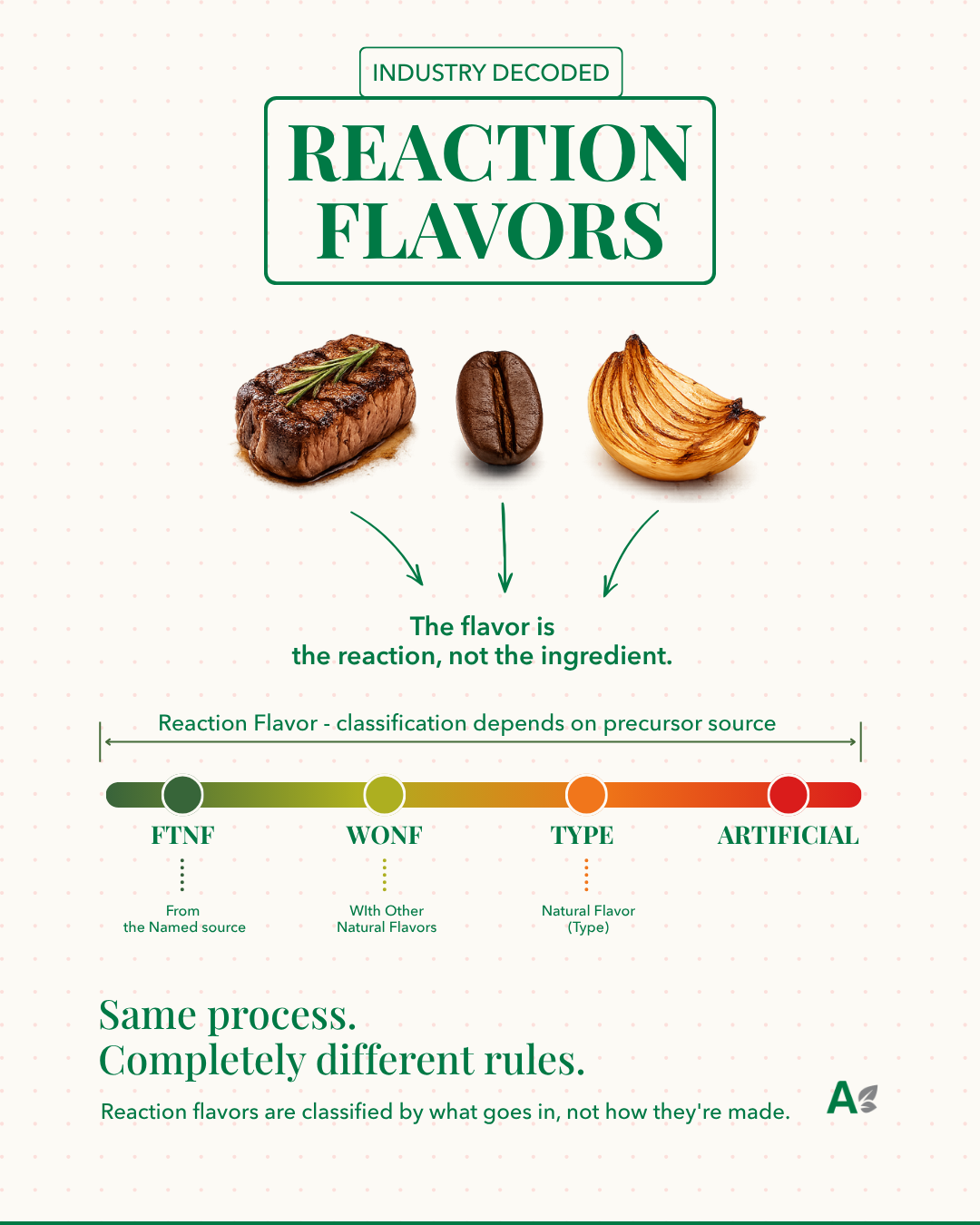
A reaction flavor is created by heating specific precursor ingredients, typically amino acids, sugars, and sometimes fats, under controlled temperature and pressure. The flavor doesn’t come from extracting or isolating a compound. It comes from a chemical process: the same Maillard reaction that browns your bread and sears your steak, run deliberately, with specific inputs, to produce a target flavor profile.
This puts reaction flavors in an unusual position relative to the standard spectrum. The usual framework runs from FTNF (from the actual named source) through WONF and TYPE out to Artificial. Reaction flavors don’t travel that line. Their classification, natural or artificial, depends entirely on the starting materials. If the precursors are natural-source ingredients, the result can be labeled natural. If any synthetic material enters the reaction, it shifts to artificial.
The regulatory reason this category exists is practical: some flavors can only be created through process, not extraction. You can’t cold-press “roasted coffee.” You can’t steam-distill “braised short rib.” The flavor is created by the reaction, not extracted from the ingredient.
The implication for your work: if you’re briefing savory, roasted, caramelized, or grilled notes, there’s a good chance the solution you receive is reaction-derived, not an extract, not an isolate. Understanding that distinction matters when reviewing a spec, evaluating cost-in-use, or confirming label compliance. Ask your flavorist directly. “Is this reaction-derived?” is worth adding to your brief review checklist.
Next up: Natural Flavor, the FDA definition is broader than almost anyone expects.