|
|
|
The fortune cookie itself is not Chinese.
It descends from tsujiura senbei, a Japanese cracker sold near Kyoto shrines, brought to California by Japanese bakers in the early 1900s and adopted by Chinese restaurants after WWII.
In China, most people have never seen one.
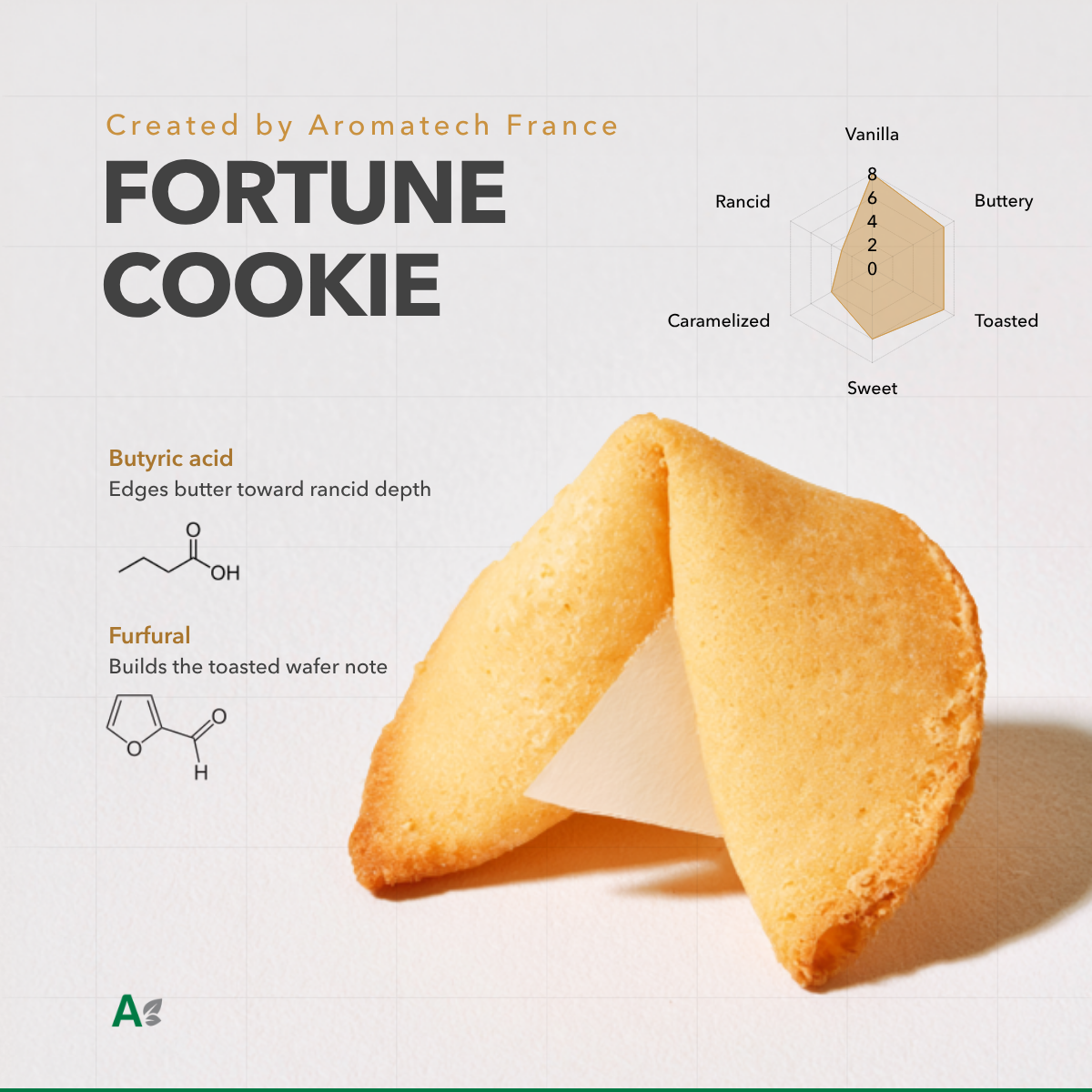
Matching a biscuit this simple takes unreasonable precision. Vanillin carries the sweet backbone, but the character lives elsewhere:
🧈 Butyric acid covers two descriptors at once, buttery and slightly rancid.
In butter it stays mostly locked up as glycerides. Free, it reads as rich buttery warmth at trace levels and turns rancid just above them. Its pKa of 4.8 makes the window pH-dependent: an acidic syrup keeps it protonated and volatile, so the same dose that whispers in a dessert cream can shout in a beverage base.
🍞 Furfural builds the toasted note.
It forms when pentose sugars dehydrate on the batter’s surface, and a fortune cookie is nearly all surface, a millimeter of batter on a hot plate. The brief here is delivering that oven chemistry to products that never see one: a latte, a mochi, a cold dessert cream.
Natural. Allergen-free. Halal. Kosher. Vegan.
Built for dessert creams, syrups, lattes, and mochi.
Want to try it yourself? ➡️ Request a sample