|
|
|
The smell of cut grass is not a flavor. It is a distress signal.
We call it the “Green Flash.”
Biologically, it is a metabolic cascade. When a leaf is damaged, Lipoxygenase enzymes break down cell membranes instantly. The result is a burst of C6 volatiles.
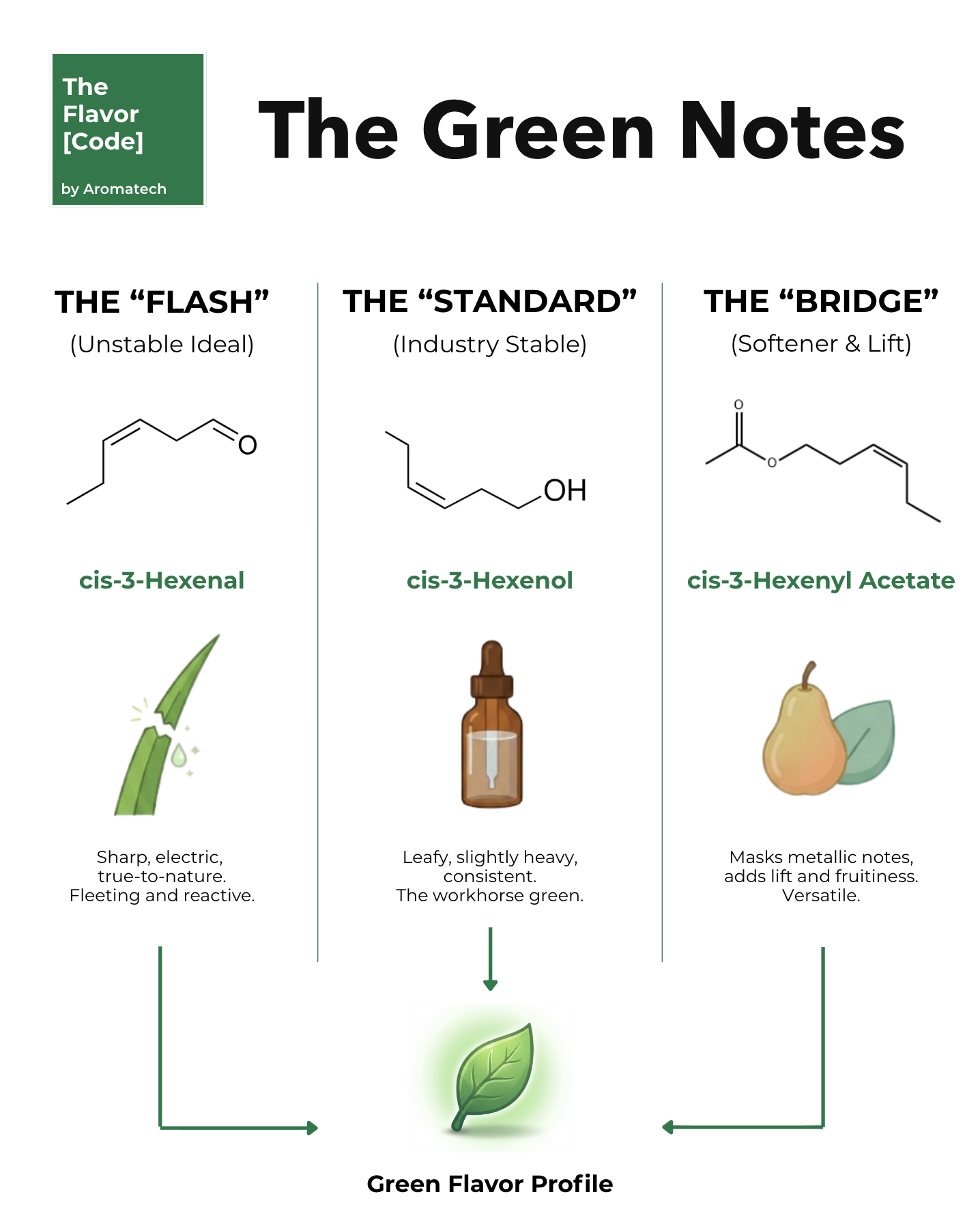
At the center of this explosion is cis-3-Hexenol (Leaf Alcohol).
Every junior flavorist knows this bottle. It is the industry standard for “Green.” You add it to Strawberry to make it jammy. You add it to Tomato to make it vine-ripe.
But here is the pain point we see on the bench.
You cannot bottle the “Flash.”
In nature, the alcohol comes paired with its aldehyde counterpart, cis-3-Hexenal. The aldehyde is what gives that sharp, vibrating electric green note.
The problem? The aldehyde is aggressively unstable. It isomerizes into trans-2-hexenal (Leaf Aldehyde) within minutes of extraction.
So, when you formulate a “Fresh Green Tea” or a “Natural Mojito,” you are usually working with the Alcohol (cis-3-hexenol) and the trans-isomer of the aldehyde.
You are painting a picture of freshness using “stale” paint.
This creates the “Synthetic Green” effect. If you overdose the cis-3-Hexenol to compensate for the missing aldehyde punch, the profile shifts from “Meadow” to “Solvent.”
The workaround is not more C6. It is masking the gap.
Freshness is not a static ingredient. It is a kinetic event.
Stop trying to preserve it. Start trying to mimic the event.