|
|
|
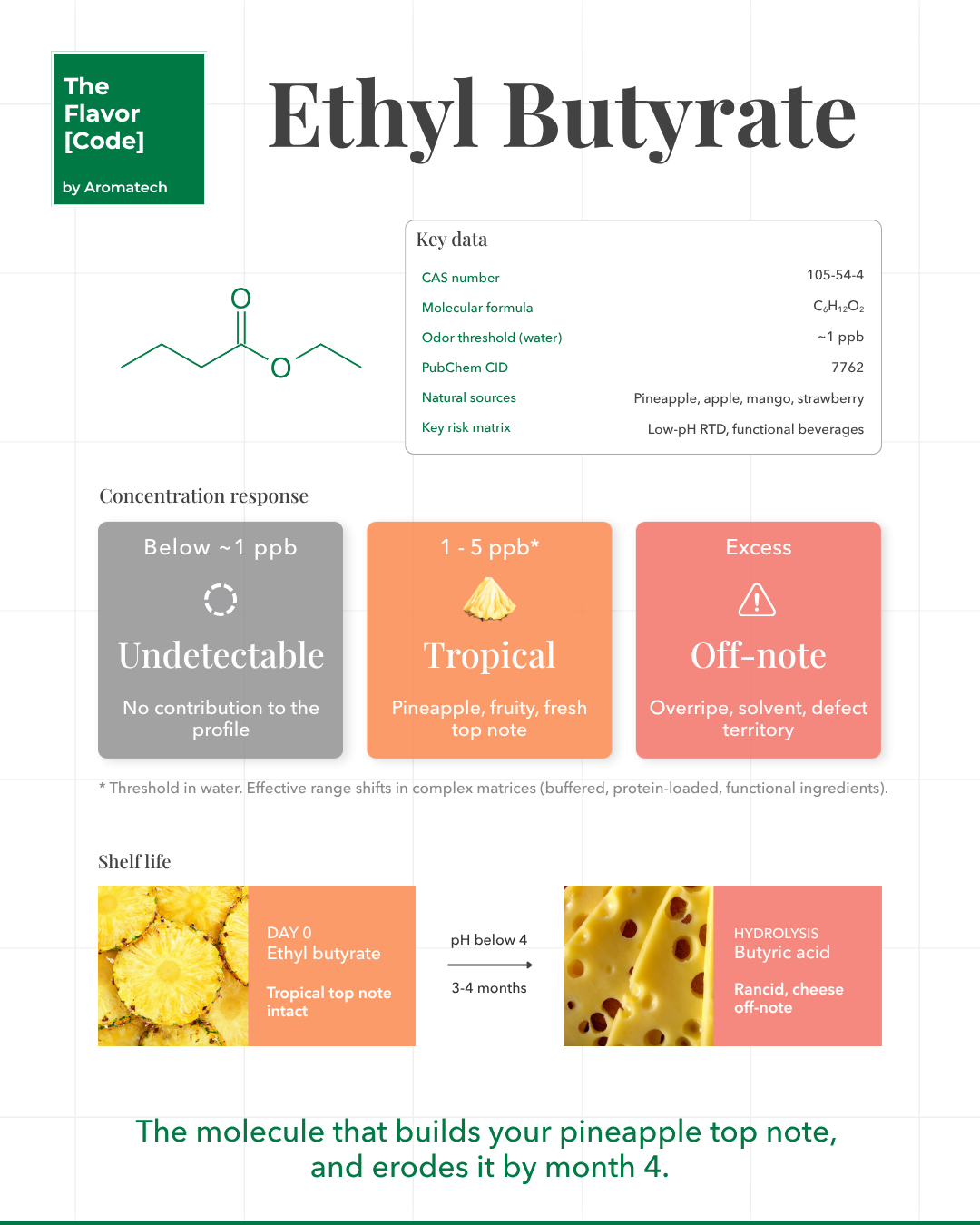
Your pineapple note and your future off-note can come from the same molecule.
Ethyl butyrate is one of the most precisely dosed esters in functional beverage formulation.
At the right concentration, it delivers a clean, ripe tropical top note that is instantly recognizable as pineapple. Below its effective threshold, its contribution becomes minimal. Push it too high, and the profile can shift from ripe fruit to overripe fruit, solvent-like notes, and eventually into defect territory.
Reported detection thresholds in water are often in the low-ppb range. In a real beverage system, that number moves.
Buffering systems, carbonation, protein content, creatine, B vitamins, and other functional ingredients can all change how the ester is perceived. The trap is formulating against a published threshold instead of determining the effective threshold in your actual matrix.
The bench sample passes. The production batch doesn’t.
The second challenge develops more slowly.
Ethyl butyrate is an ester, and esters hydrolyze over time. In acidic beverage systems, particularly citrus-forward products built around low-pH stability and masking, the ester bond can gradually break down, releasing butyric acid.
Butyric acid is commonly described as rancid butter, aged cheese, or parmesan rind. It is not the aroma you intended when you selected a bright tropical top note.
The rate of hydrolysis depends on the system. pH, temperature, flavor delivery format, and storage conditions all matter. In some formulations, the impact can become noticeable within months rather than years.
Two things help:
First, validate the effective threshold in your system, not in the literature.
Second, if your shelf-life target extends beyond six months and your formulation operates below pH 4, pay attention to delivery format and stability strategy. Encapsulation can materially improve ester stability, and even modest increases in pH can meaningfully slow hydrolysis.
Your bench sample is not a prediction.
It is a starting condition.