|
|
|
One molecule at the right dose tastes like freshly churned butter. At twice the dose, it tastes like a microwave bag.
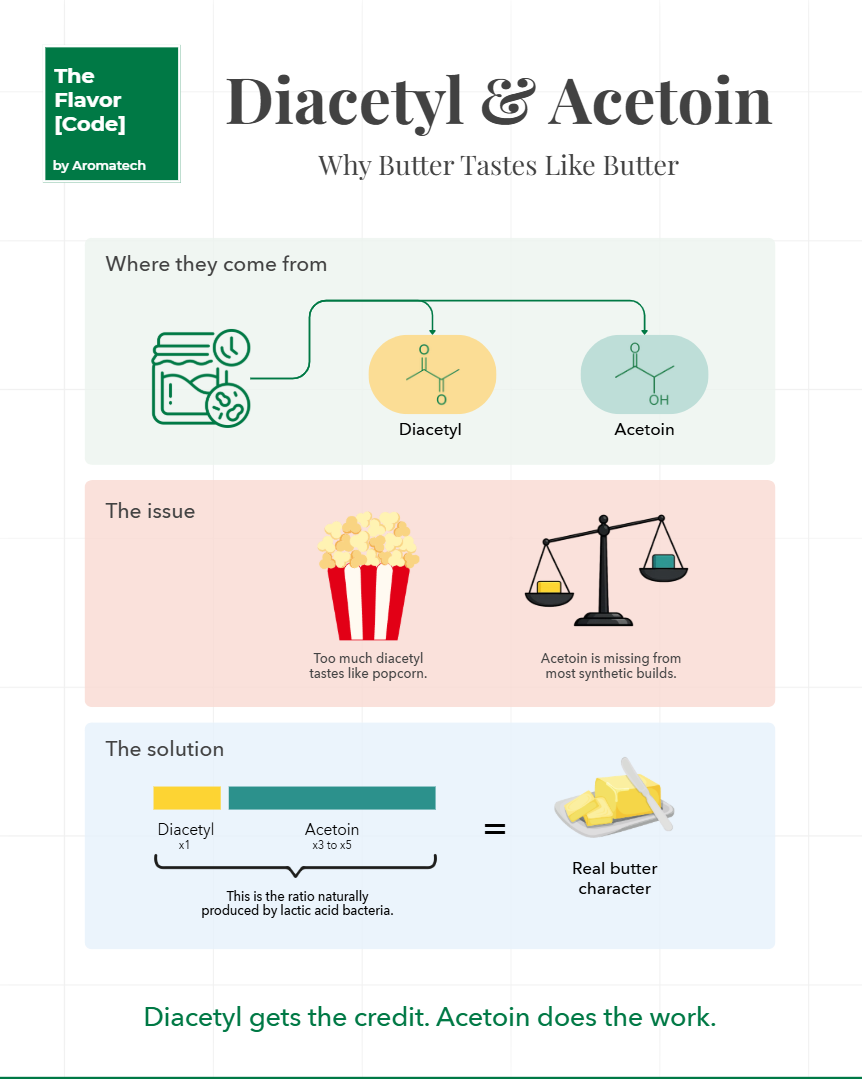
That molecule is diacetyl (2,3-butanedione). And the reason it is so hard to work with is not the molecule itself , it is its quieter, more forgiving companion: acetoin (3-hydroxy-2-butanone).
Diacetyl and acetoin are vicinal diketones produced side by side during microbial fermentation. Lactic acid bacteria generate both in yogurt, butter, wine, and beer. In real dairy fat, they do not exist in isolation, they exist in ratio. That ratio is what makes “real butter” feel real.
The formulation problem: diacetyl has a detection threshold around 0.005 mg/kg in neutral dairy bases. At low levels, it reads as creamy and round. Push past the threshold and it flips, flat, fake, popcorn, artificial. Acetoin sits at roughly 0.15 mg/kg in the same matrix. It does not read as “butter” on its own, but it scaffolds diacetyl’s character, softening its top note and extending the buttery finish without crossing into caricature.
If you are building a dairy butter flavor for plant-based applications and your bench sample smells right but production batches keep overshooting, the answer is almost never “reduce diacetyl.” It is usually: increase the acetoin load relative to diacetyl, and let the ratio do the work.
The target: a diacetyl-to-acetoin ratio around 1:3 to 1:5 in most neutral dairy bases. Natural fermented butter profiles land there organically. Synthetic builds miss it because they optimize for the impact molecule and skip the scaffold.
Diacetyl gets the credit. Acetoin does the work.