|
|
|
The same molecule that makes a peach taste like summer can make your finished product smell like paint thinner.
The difference is a few parts per million.
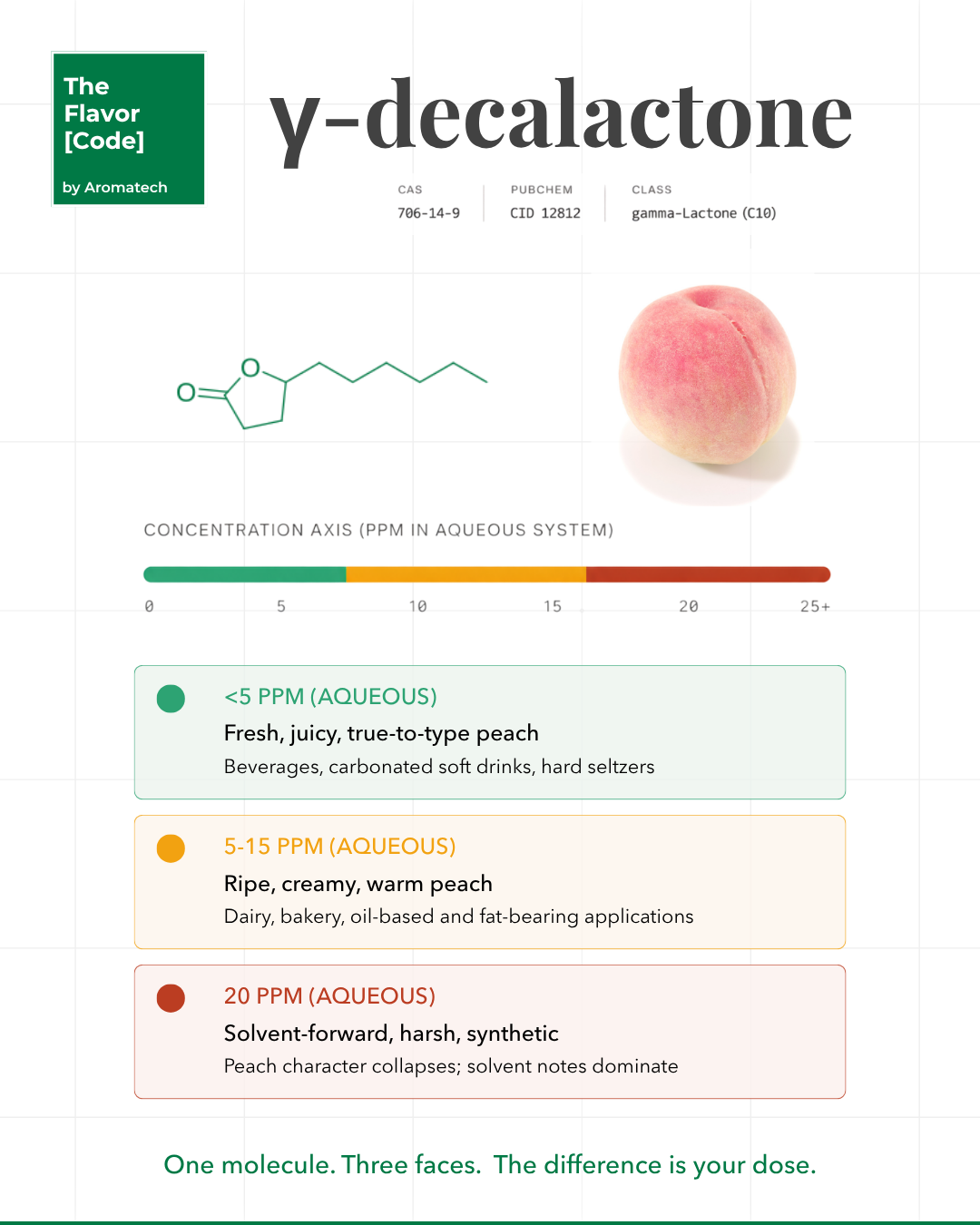
γ-decalactone is the compound responsible for the defining character of peach in food and beverage. In peaches, reported concentrations are typically in the low mg/kg range, often around 0.5-4 mg/kg depending on cultivar and ripeness. In a formulation, that reference window means almost nothing, because your matrix changes everything.
Here is what happens across the concentration axis:
🟢 Below 5 ppm (aqueous): fresh, juicy, true-to-type peach. Clean topnote, bright skin character.
🟡 5 to 15 ppm: ripe, creamy, warm. Excellent in dairy, bakery, and fat-bearing applications.
🔴 Above 20 ppm: solvent-forward, harsh, and overtly artificial. Peach character is overwhelmed by off-notes.
The trap is matrix partitioning. Build your profile in an aqueous system and γ-decalactone releases readily into the headspace, so the peach note reads strong. Move that same formula into an emulsified product or a fat-bearing matrix and the molecule partitions into the lipid phase. Volatile release slows. The peach disappears on the palate.
The reflex is to add more. That is exactly when you cross the line.
The fix is not more γ-decalactone. Pair it with δ-decalactone for depth, persistence, and body in fat-rich systems, and calibrate your working dose to the finished matrix, not to an aqueous bench evaluation.
One molecule. Two very different systems. And a formulation cost difference between “we nailed it” and “we reformulate.”