|
|
|
Coconut rice is Southeast Asian by birth. Across Africa today, it appears on some of the most convivial plates around, served alongside meats and cassava leaves, familiar, comforting, and deeply rooted in local food culture.
Two cultures. One profile. A surprisingly layered formulation brief.
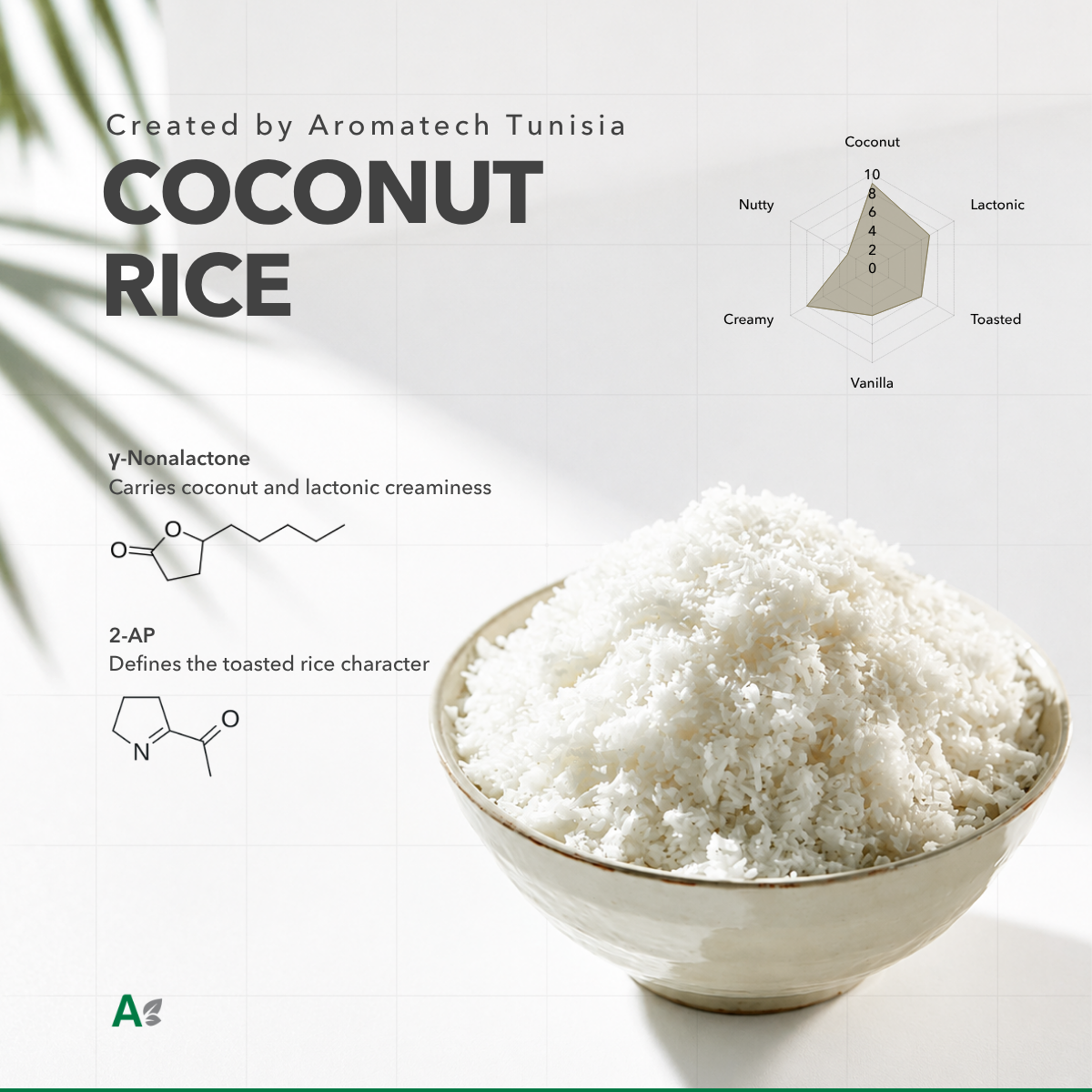
Four descriptors on paper: coconut, lactonic, toasted, and vanilla. Here is what is actually doing the work.
🥥 γ-Nonalactone: the coconut and lactonic notes are not two separate things. They are largely driven by the same molecule.
This lactone is naturally present in coconut and contributes both the characteristic creamy coconut note and the smooth, rounded lactonic depth that keeps the profile approachable. Because it is fat-soluble, it performs particularly well in applications such as ice cream and fillings. In water-based systems like syrups, proper emulsification helps maintain flavor consistency throughout shelf life.
🍚 2-Acetyl-1-pyrroline (2-AP): the toasted note is the most technically demanding part of this profile.
2-AP is one of the key aroma compounds responsible for the characteristic aroma of jasmine and basmati rice. Its detection threshold is measured in parts per billion, making it one of the most potent aroma compounds used in flavor creation. At the right level, it delivers an unmistakable toasted rice character. Slightly over and the profile can shift toward popcorn-like or overly roasted notes, competing with the coconut roundness rather than supporting it.
The vanilla note acts as a bridge between the creamy coconut body and the toasted rice character, rounding sharp edges and helping the profile feel complete rather than segmented.
Halal. Kosher. Vegan. Natural version available.
Classic applications: syrups, ice cream.
Emerging applications: savory sauces, fillings, and culinary-inspired snacks.
Both directions are on the table, which application would you explore first?
→ Samples: https://forms.office.com/r/mgz0HCVTcA