|
|
|
So you are formulating a Concord grape beverage.
You add Methyl Anthranilate for that authentic dark berry anchor.
And it tastes perfect on day one.
But by month three the liquid turns bright yellow.
And the grape flavor completely drops out.
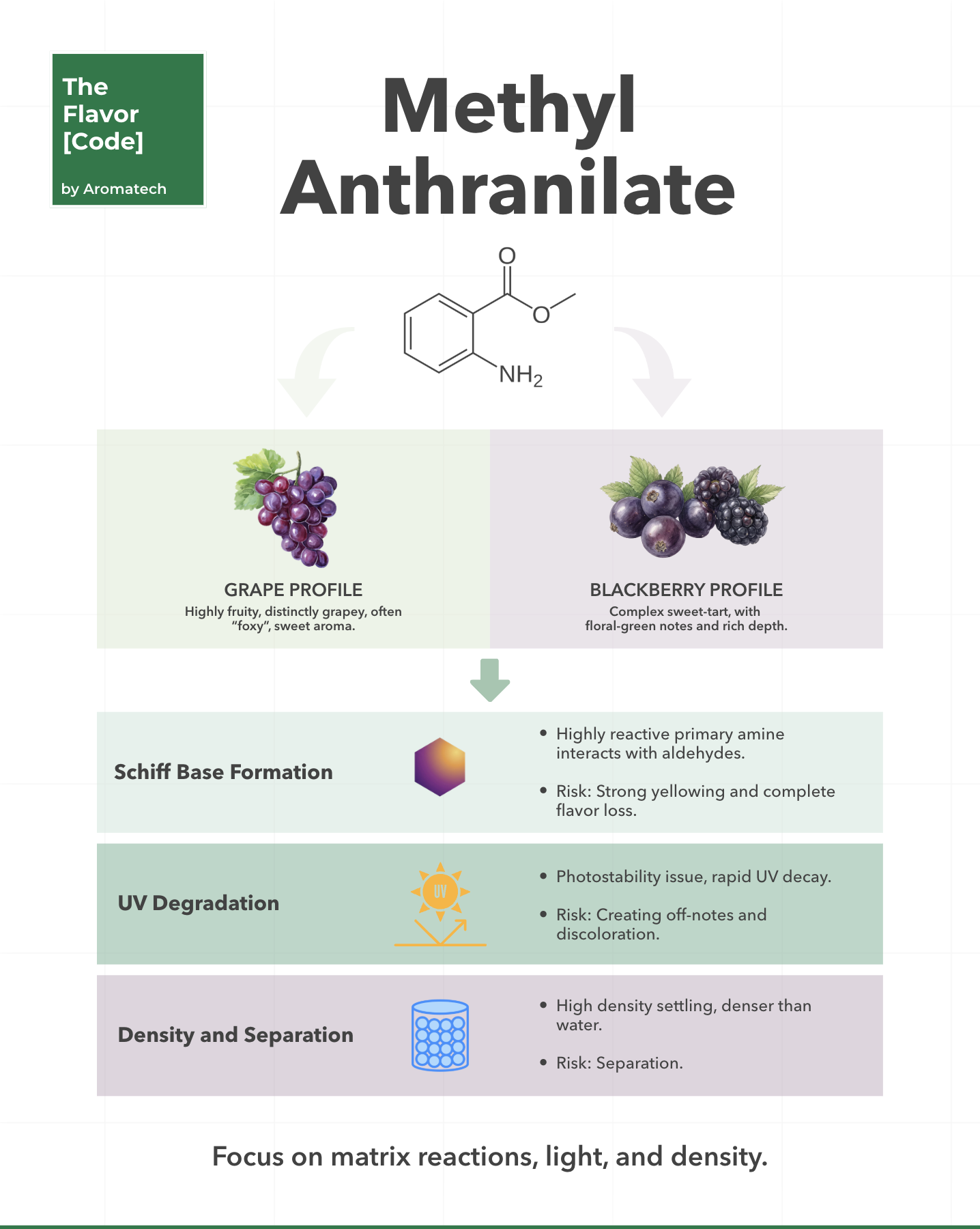
You are watching a Schiff base reaction in real time.
Methyl Anthranilate has a highly reactive primary amine.
When it meets an aldehyde in your matrix it condenses.
Maybe you used citral for a citrus lift.
Or maybe you used ethyl vanillin to push the sweetness.
The amine and the aldehyde lock together to form a heavy pigment.
Your volatile flavor is now a non-volatile yellow compound.
And the physical constraints are just as brutal.
This molecule is significantly denser than water.
It will literally sink to the bottom of your mixing tank without proper stabilization.
Here is how you protect the system.
🧪 Keep aldehydes out of the formulation to prevent condensation.
☀️ Block UV light completely to prevent rapid photolytic degradation.
🌀 Use high shear emulsification or cosolvents to prevent the molecule from dropping out of aqueous suspension.
Making a great flavor is easy. But keeping it alive on the shelf is the actual job.