|
|
|
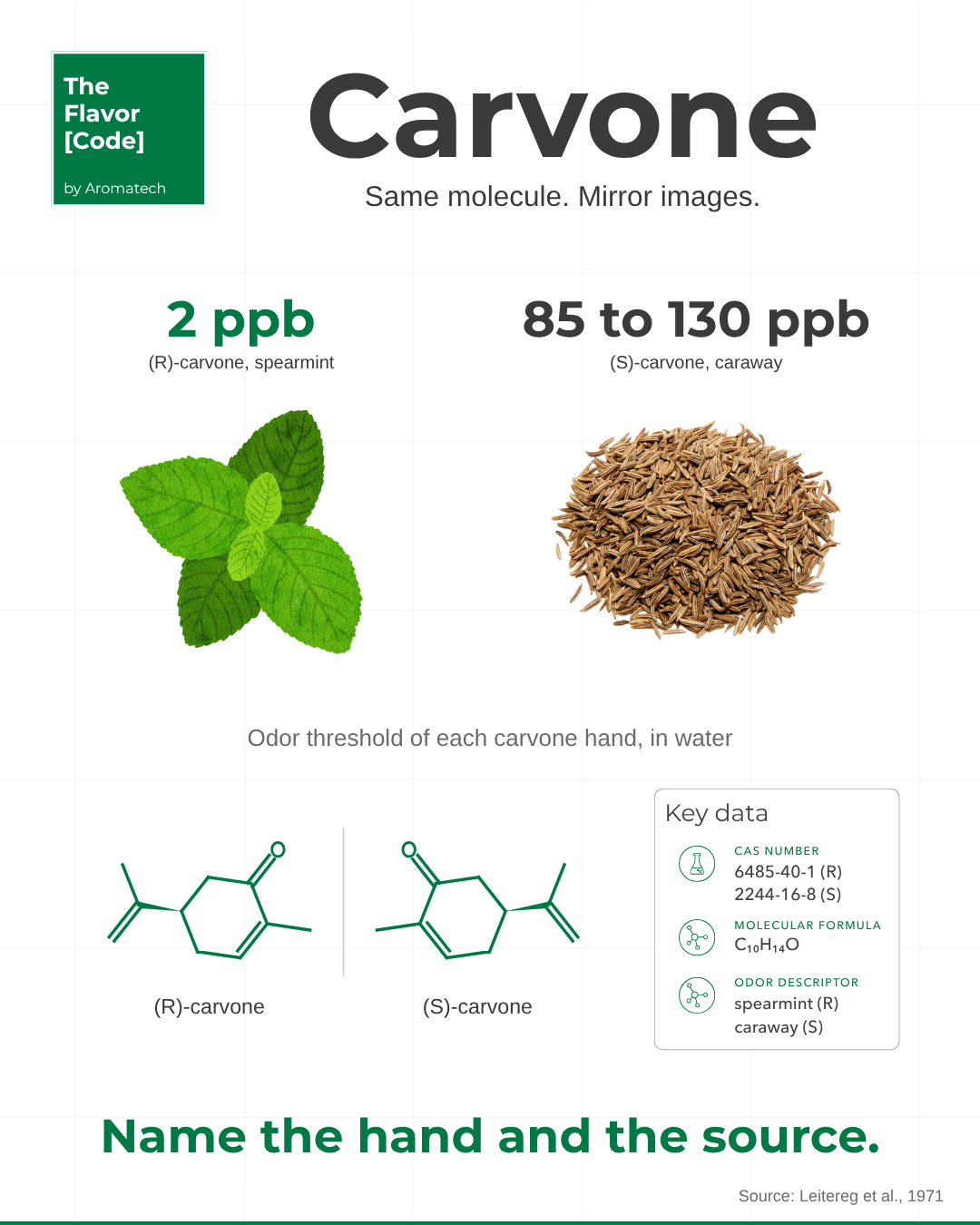
Spearmint gum and rye bread taste nothing alike. Their signature aroma comes from the same molecule, in mirror image.
That molecule is carvone. Same atoms, same bonds. Only the 3D layout around one carbon differs, the way a left hand differs from a right. Smell receptors are chiral proteins themselves, so they read the two hands as two flavors.
(R)-carvone is the main note of spearmint oil. (S)-carvone is the caraway seed note in rye bread, and the main note of caraway and dill seed oil. In water, a 1971 study detected the spearmint hand at 2 ppb and the caraway hand at 85 to 130 ppb.
A fair objection is that a trace impurity could explain the gap. That study purified both forms, and the difference held.
So “carvone” on a spec sheet is half a spec. Name the hand, or a caraway note can turn up in a mint brief.
Then name the source. The same (R)-carvone can also be made from orange peel limonene by chemical conversion. Same molecule, but in the US it is not a natural flavor under 21 CFR 101.22(a)(3). Spearmint oil is.
If your brief says spearmint, the hand and the source are already decisions. Write them down.
Explore our flavor catalogue: https://aromatech-portfolio.vercel.app/index.html