|
|
|
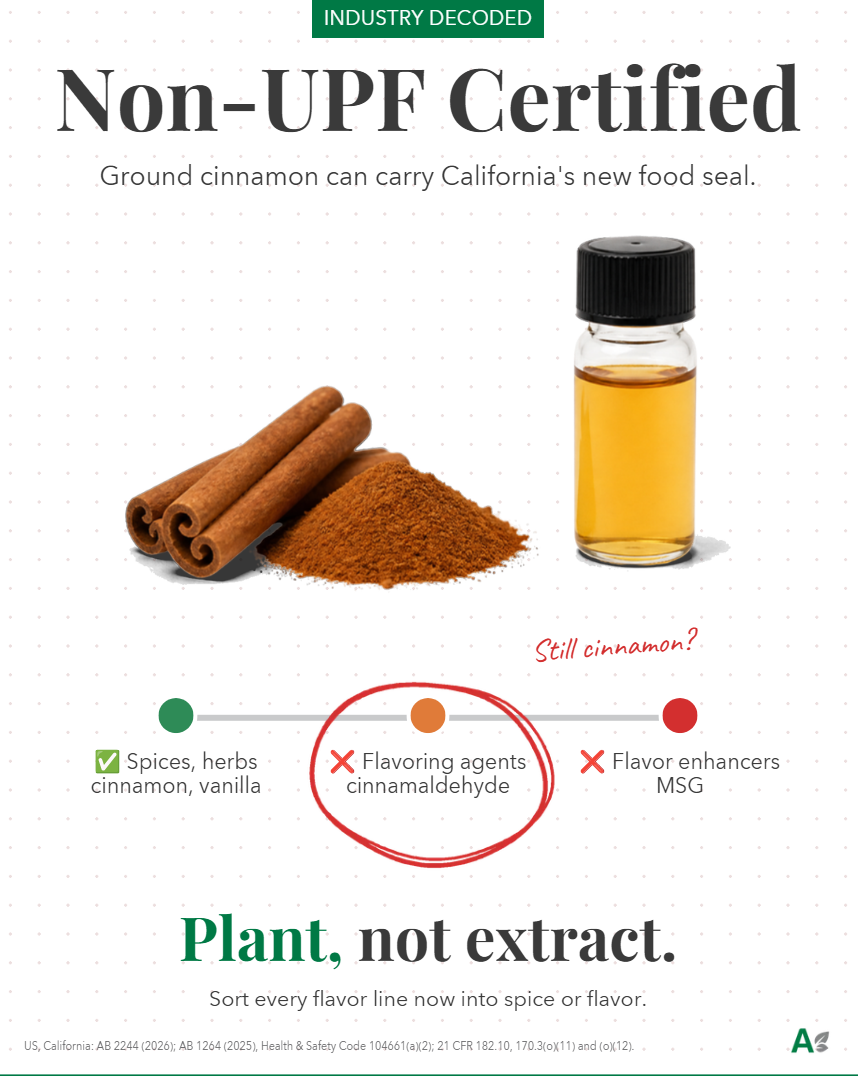
Ground cinnamon can carry California’s new food seal. Cinnamaldehyde, the molecule that makes cinnamon taste like cinnamon, cannot.
The seal reads “Non-UPF Certified.” Governor Newsom signed it into law on September 28, 2026 (AB 2244), and the state must accredit the first certifiers by June 1, 2029.
It is a voluntary seal for foods that meet none of the additive criteria in California’s 2025 ultraprocessed food definition. For anyone who builds flavor, the criteria split in a simple way. Spices and herbs on the federal list, such as cinnamon, vanilla and ginger, are allowed. Flavoring agents are ruled out, natural or synthetic, cinnamaldehyde included. Flavor enhancers such as MSG are ruled out too, along with nonnutritive sweeteners.
The criteria come from AB 1264, the 2025 law that gave California the first legal definition of ultraprocessed food. It borrows FDA’s technical effect classes, and its only flavor exemption points to one list, 21 CFR 182.10, which names spice and herb plants one by one. Cinnamon bark oil sits on a different federal list, so it gets no exemption by name.
A natural flavor extracted from cinnamon is still cinnamon, and that is a fair argument. On the text as signed, it has to be made to the California Department of Public Health and the certifiers, because the exemption covers the listed plant and says nothing about what is extracted from it.
If a California seal is on your roadmap, sort every flavor line now into spice or flavor, and ask your flavor house which profiles can be rebuilt on listed botanicals.
Our read of the text: almost every “natural flavor” line on a bakery or cereal label today keeps that product off this seal.
Explore our flavor catalogue: https://aromatech-portfolio.vercel.app/index.html