|
|
|
Introduction
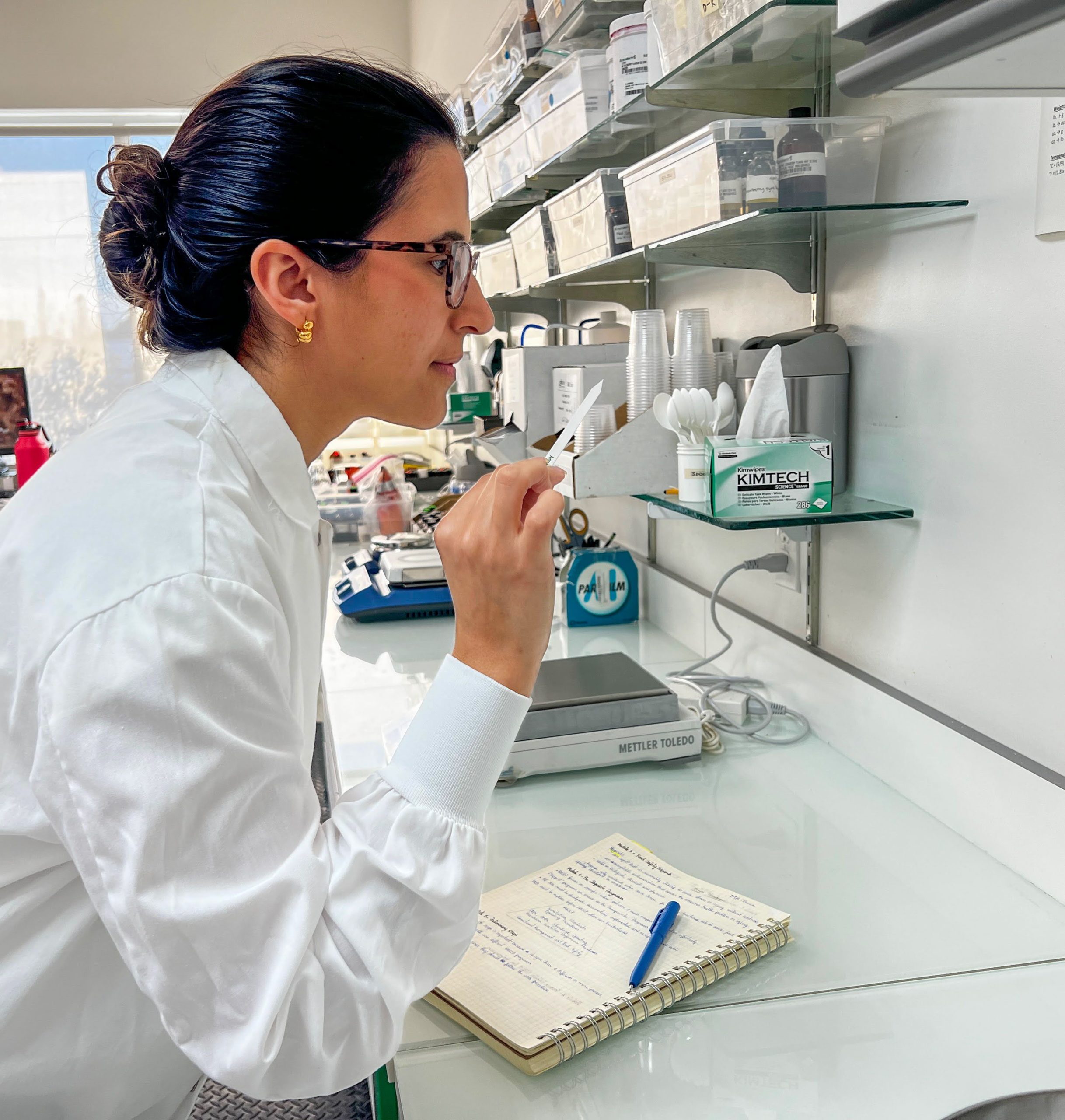
Rebecca: I’m Rebecca. I am Brazilian, and I have been living here in the United States since May 2024. I started working at Aromatech in July. Before this, I had experience in the quality sector at a multinational company in Brazil where I worked as a specialist. Here, I am handling that role and learning about food safety. Outside of work, I’m married, have no kids, and I love going to the beach and watching TV shows.
You have a background in Chemical Engineering and worked in the leather division at JBS. What was the biggest shock moving from that industrial environment to the nuance of the flavor industry?
Rebecca: The team accepted me with open arms, which helped me learn to love it. When it comes to flavors, my biggest shock was starting to work in a food company.
In general, Quality is about adequacy and conformance to customer expectations. But in the food industry, food safety requirements are mandatory for customer satisfaction and safety. That is a really big, important part of the industry. It was really new to me because I worked in leather, where we have requirements, but nothing related to that. This was a completely new universe for me. We work daily to build and maintain our quality system to protect and ensure the safety of our products.
Another aspect that really caught my attention is that flavors themselves are very complex, with many layers. I am still learning a lot, but when I participate in a triangle test, I feel like a detective trying to identify clues in a mystery. I have also become addicted to reading ingredient labels to see whether there are any flavors contributing to the taste of products I buy.
Quality Assurance is often seen as the “police” or the “blocker” of fun ideas. How do you flip that script to be a partner to R&D rather than just an enforcer?
Rebecca: That is really true. I walked into a conversation last week and a lady said something like that to me! When I tell people that I work in Quality, dealing with documents, standards, and certifications, they often wrinkle their foreheads.
I believe this reaction comes from an outdated mindset that sees Quality as a department rather than a system integrated into all areas of the company. Fortunately, here at Aromatech, I have had open doors since the beginning to discuss topics and present the necessary requirements. Our R&D team, along with all other areas, are strong contributors to achieving the goals we have for our quality and food safety system.
Alyssa mentioned customers are obsessed with “clean label” and “functionality”. As the person who validates those claims, where do brands usually get it wrong or underestimate the difficulty?
Rebecca: I believe one of the main challenges for both brands and the supply chain is the lack of a formal FDA definition for claims such as “clean label” and “functionality.” These concepts are largely driven by consumer perception rather than regulation.
If you search for an FDA definition of what a clean label is, they don’t give you a statement. It varies from person to person. Clean label, in particular, is a social movement, and what is considered “clean” can vary significantly from one customer to another. For some, a clean product means no pesticides, making organic products the clear choice. For others, clean label means no synthetic additives, in which case natural flavors or a simplified ingredient list becomes the priority.
Because of this variability, the real challenge on our side is to clearly understand how the brand defines clean label or functionality for its specific consumer target. Only then can we help with solutions that are technically feasible, compliant, and aligned with the brand’s positioning. Our role is to translate these subjective expectations into clear technical requirements to ensure the final product accurately delivers what the brand is promising.
Your profile mentions “Food Fraud prevention”. That sounds intense. Can you give us a specific example of what food fraud actually looks like in the flavor world?
Rebecca: I’ll tell you a story. My grandfather had a small farm in the countryside of Brazil, and he sold milk to people in the region. At the time, he dealt with competitors selling milk mixed with water to get more profit. This is food fraud. I heard this story when I was a teenager, but when I started learning about food safety here, I connected the dots.
Food fraud is part of real history, and it is intentional adulteration driven by economic gain. In the flavor industry, this type of adulteration can take different forms. A common example is the use of synthetic substances in products marketed as “natural,” which misleads the consumer and reduces production costs.
Another example is the addition of compounds to artificially inflate analytical results, such as the historical use of Melamine to falsely increase protein values. Melamine has a lot of nitrogen in its composition, and the tests which calculate protein look for nitrogen. So, when you add Melamine, the nitrogen levels grow, and the test says, “Hey, you have this amount of protein,” but part of that is actually the substance you added. It is not a protein source.
To prevent this, we maintain a robust supplier approval and qualification program. In addition, we conduct food fraud vulnerability assessments and continuously monitor global and local food fraud alerts to anticipate risks.
You handle the massive task of FSSC 22000 and Organic certifications. What is the one small detail that usually trips people up during an audit?
Rebecca: Audits often make people uncomfortable because they feel like an external person is coming to their home to examine their habits and point out mistakes. However, this mindset is often what causes companies to struggle.
When teams try to mask issues or tell auditors what they think they want to hear, gaps usually surface quickly and the narrative falls apart. I believe the first thing that needs to change is the perception of an audit as a “finger-pointing” exercise. In reality, audits increase organizational maturity. An external perspective helps identify areas that truly need correction and can even anticipate larger issues before they escalate.
Of course, organizations must do their homework and maintain a culture of continuous improvement, but the most important thing is to demonstrate what actually happens in their operations, not a version prepared only for the auditor.
I remember an experience I had before working here. During an external audit, a production supervisor showed a good action plan for a project they had. It looked like a good idea on paper, but it was totally disconnected from the strategic action plan, and the other people in the factory didn’t know about it. It was good on paper, but out of the quality system, which nearly led to a non-conformity.
You are a native Portuguese speaker and have supported global units before. How does that international perspective help you navigate regulations here in the US?
Rebecca: I previously worked with teams in Italy, Vietnam, the United States, Argentina, and Uruguay, and we would take English as a common language. Now, I use English on a daily basis here.
What I learned from those experiences is that communication is more important than perfect pronunciation. I have significantly improved my vocabulary, and although I know I sometimes need to correct words, I always make sure people understand what I want to say. I have seen situations where native speakers were not able to clearly express their ideas, and those communication issues grew into major problems.
Because of that, I believe my previous experience helps me work here by being careful and intentional with my training, emails, and requests. Regulations are complex in every country, you can read a regulation and still not understand it. I always try to make people understand the “what” and the “why” of what the regulation expects. The most important thing is the communication part, more than the language itself.
If you had to describe Aromatech’s approach to quality in one word, what would it be and why?
Rebecca: Collaborative.
As I mentioned before, we have open communication across all areas with strong partnerships between teams. Quality is supported by cross-functional collaboration; it is not the responsibility of a single department, but of everyone in the organization.
When I entered Aromatech, I had a quality background but had to learn the food safety path. I had so much help from QC, R&D, General Management, Sales, and Marketing. Everyone helped me with their points of view. That is why I think it is a well-integrated system.
And lastly, what is your favorite flavor?
Rebecca: My favorite flavor is always related to chocolate. So, I think cocoa flavor or chocolate flavor. I always choose chocolate desserts, ice creams, or anything like that!