|
|
|
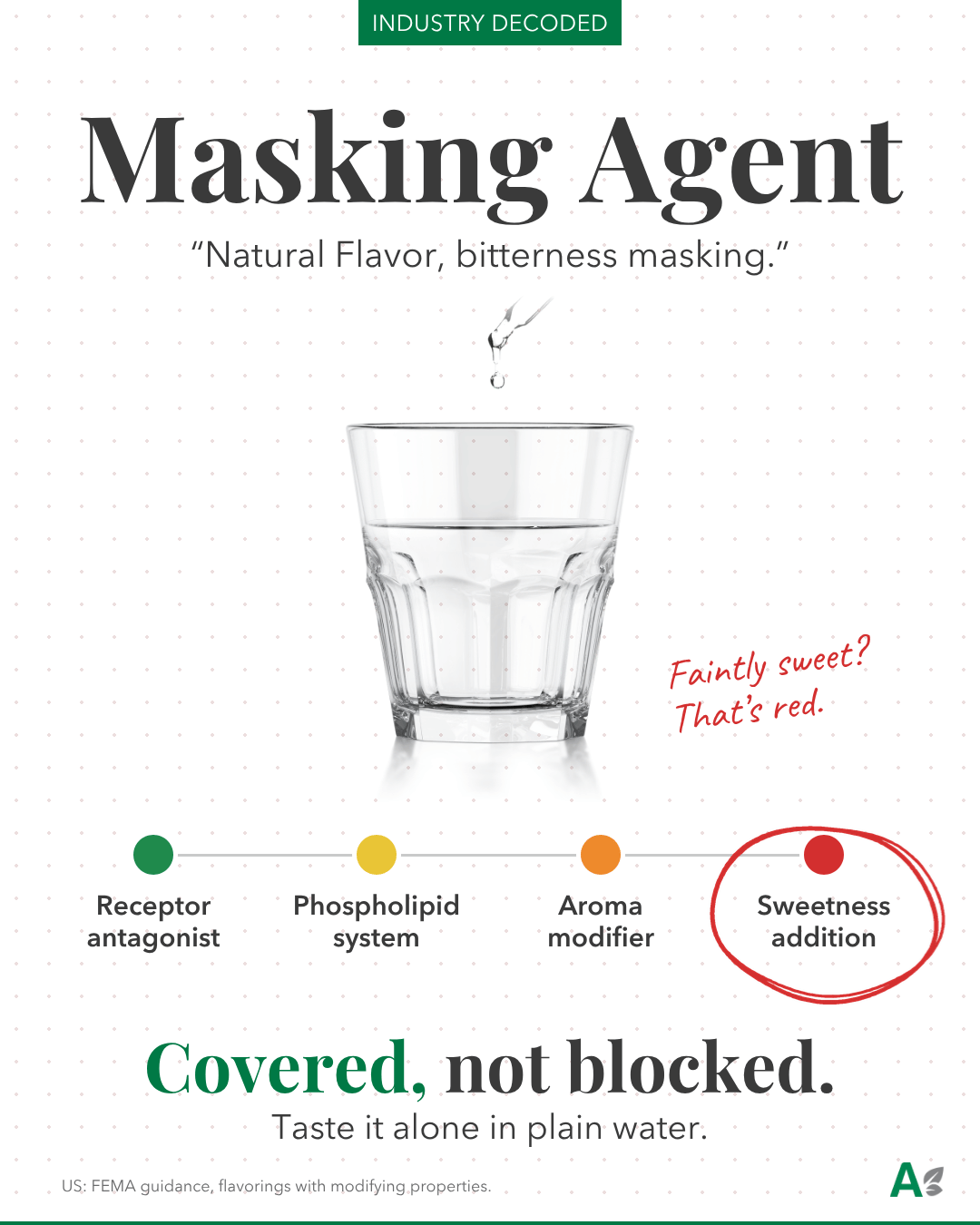
A lot of what is sold as bitterness masking does not block bitterness. It adds sweetness under a technical name.
“Natural Flavor, bitterness masking.” Next time that line shows up on a spec, taste the ingredient alone in plain water, at its use level. If it tastes faintly sweet, you have learned most of what it does.
A masking agent is an ingredient added to reduce how much of an unwanted taste, usually bitterness, you perceive. Blocking at the receptor exists, but it is rare.
The mechanisms rank from real blocking to cover. A receptor antagonist occupies bitter receptors so they send no signal. A phospholipid system uses lipid and protein complexes that dampen bitter signals on the tongue. An aroma modifier shifts attention with aroma notes while bitterness still registers. Sweetness addition covers bitterness while the receptors keep firing.
Real blocking is rare for a reason. Humans carry about 25 types of bitter receptors, and different bitter compounds trigger different ones. GIV3727, the first published receptor blocker shown to work in human tasters (Current Biology, 2010), shut down only a small subset. Phospholipid and milk protein complexes, studied in Japan in the 1990s, are the other route with real blocking evidence.
Sweetness addition is common because the brain lets sweetness suppress bitterness, cheaply and reliably. In the US, FEMA guidance for flavorings with modifying properties draws the line. The ingredient alone, at its maximum use level, must taste significantly less sweet than 1.5% sucrose in water. Past that, FEMA treats its effect as sweetening, which needs its own regulatory clearance and a declaration on the label. In the EU, Regulation (EC) 1334/2008 excludes substances with an exclusively sweet, sour or salty taste from its scope altogether.
The strongest objection is that sweetness below that line still suppresses bitterness, and it is legal and often the right tool. Fair. But it adds to the sweetness of the finished product and does nothing at the receptor. In a sugar reduction project, the “masker” may be quietly putting back some of the sweetness you removed.
Ask your supplier which mechanism this masker uses. Then run the water test next to your product test.
Explore our flavor catalogue: https://aromatech-portfolio.vercel.app/index.html