|
|
|
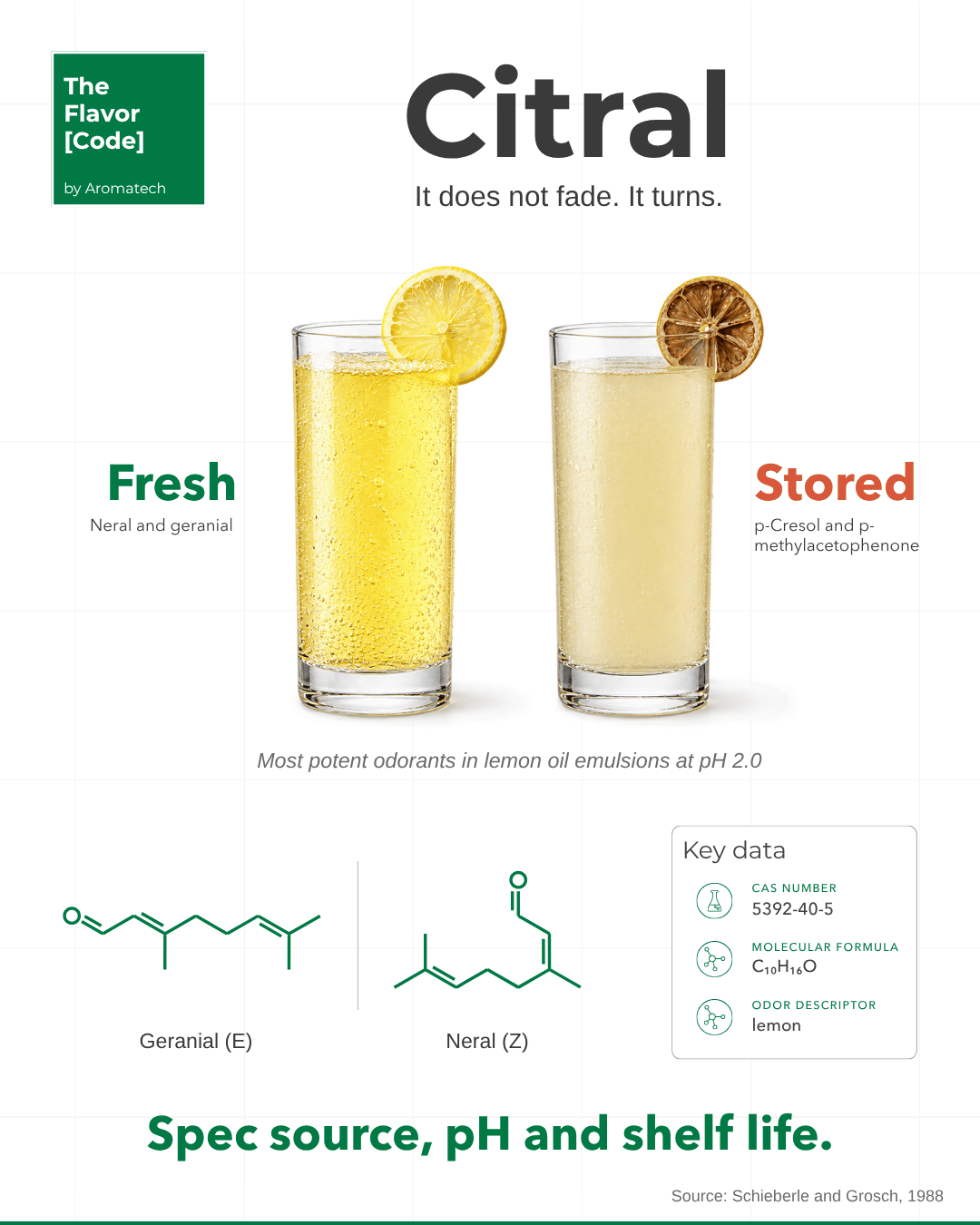
Your lemon soda does not lose its lemon on the shelf. It turns it into something worse.
The bright lemon note in a soda or an iced tea comes mostly from citral, an aldehyde made of two isomers, neral and geranial. In acid, citral reacts.
At beverage pH, acid turns citral into unstable cyclic alcohols, which then rearrange into more stable aromatic compounds. Heat, light and oxygen speed this up, and oxygen drives the step that ends at p-methylacetophenone.
In stored lemon oil emulsions at pH 2.0, neral and geranial dropped sharply, and p-methylacetophenone and p-cresol contributed most to the off-flavor (Schieberle and Grosch, 1988).
Adding more citral only buys time, since every extra molecule feeds the same reactions.
So the source belongs on the brief. Lemon oil carries roughly 2 to 5 percent citral, while lemongrass and litsea cubeba oils carry 65 to 85 percent. The molecule is the same but the load is very different, and the target pH and shelf life decide how much of it is left in the last bottle.
If your brief says lemon, it should also say pH, shelf life and citral source.
Explore our flavor catalogue: https://aromatech-portfolio.vercel.app/index.html