|
|
|
The most feared additive in the American pantry is manufactured, in large amounts, by your own body. It is also present in breast milk at higher free levels than in a bowl of ramen.
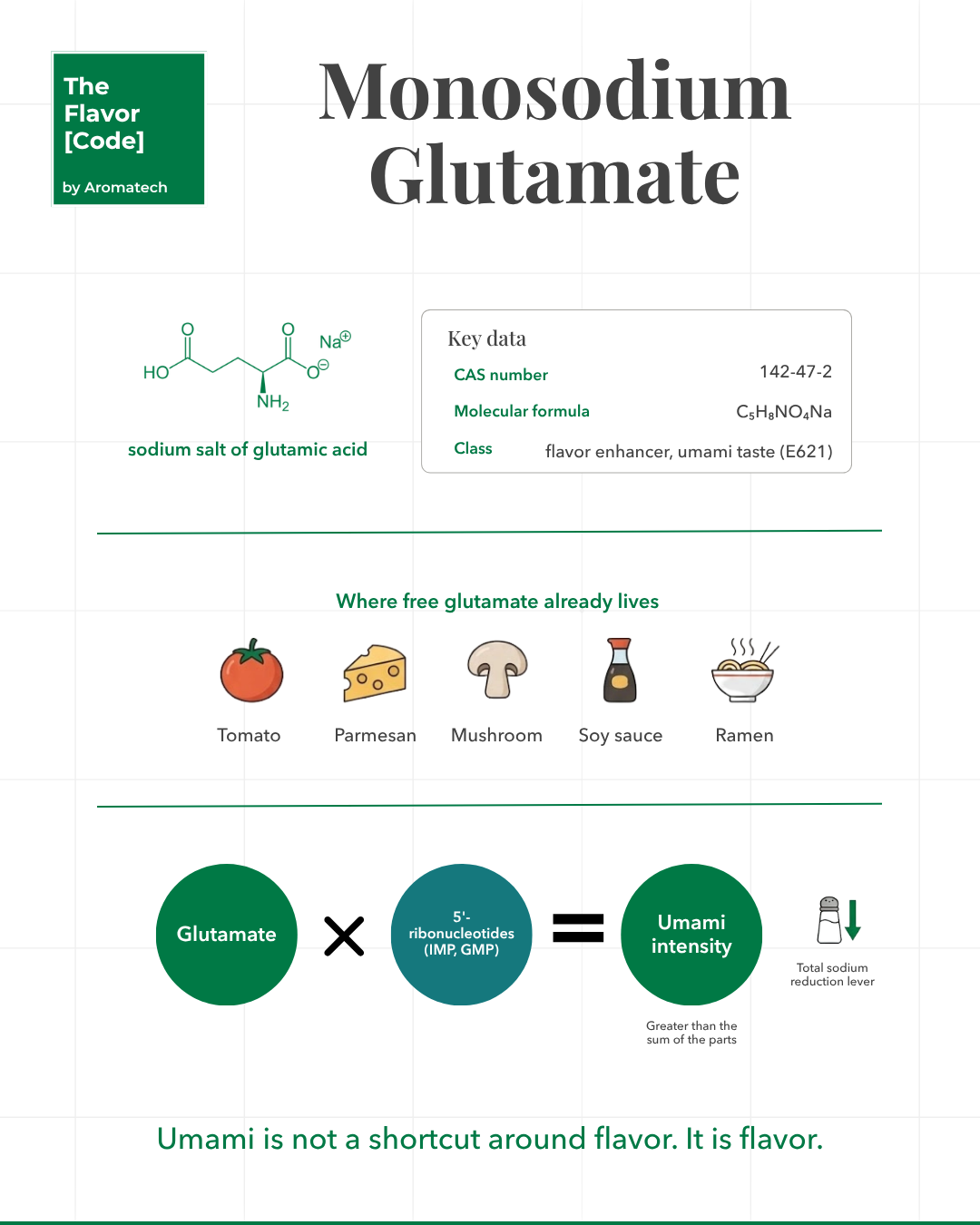
The molecule is glutamate, and it is the reason umami is a real, distinct taste. Your tongue carries a dedicated receptor for it (T1R1/T1R3), the same way it has one for sweet. Glutamate is not a trick bolted onto “real” taste. It is one of the basic tastes, sitting alongside sweet, sour, salty, and bitter.
Monosodium glutamate is simply the sodium salt of that amino acid, made stable and pourable. The glutamate reaching your receptor from a ripe tomato and from a shaker of MSG is identical.
🍅 Free glutamate is already everywhere in your pantry. Tomatoes, Parmesan, mushrooms, soy sauce, anything aged or fermented.
⚗️ Glutamate and 5′-ribonucleotides multiply each other. Inosinate and guanylate, from meat, mushrooms and yeast extracts, push perceived umami well past the sum of the parts.
🧂 That synergy is a sodium lever. A little glutamate plus a little ribonucleotide does the work of a lot of salt, so you hold savory depth while total sodium comes down.
The “MSG reaction” scare traces back to a single anecdotal letter published in 1968. Controlled studies since have not reproduced a consistent effect at normal dietary levels.
Umami is not a shortcut around flavor. It is flavor, with a receptor to prove it.