|
|
|
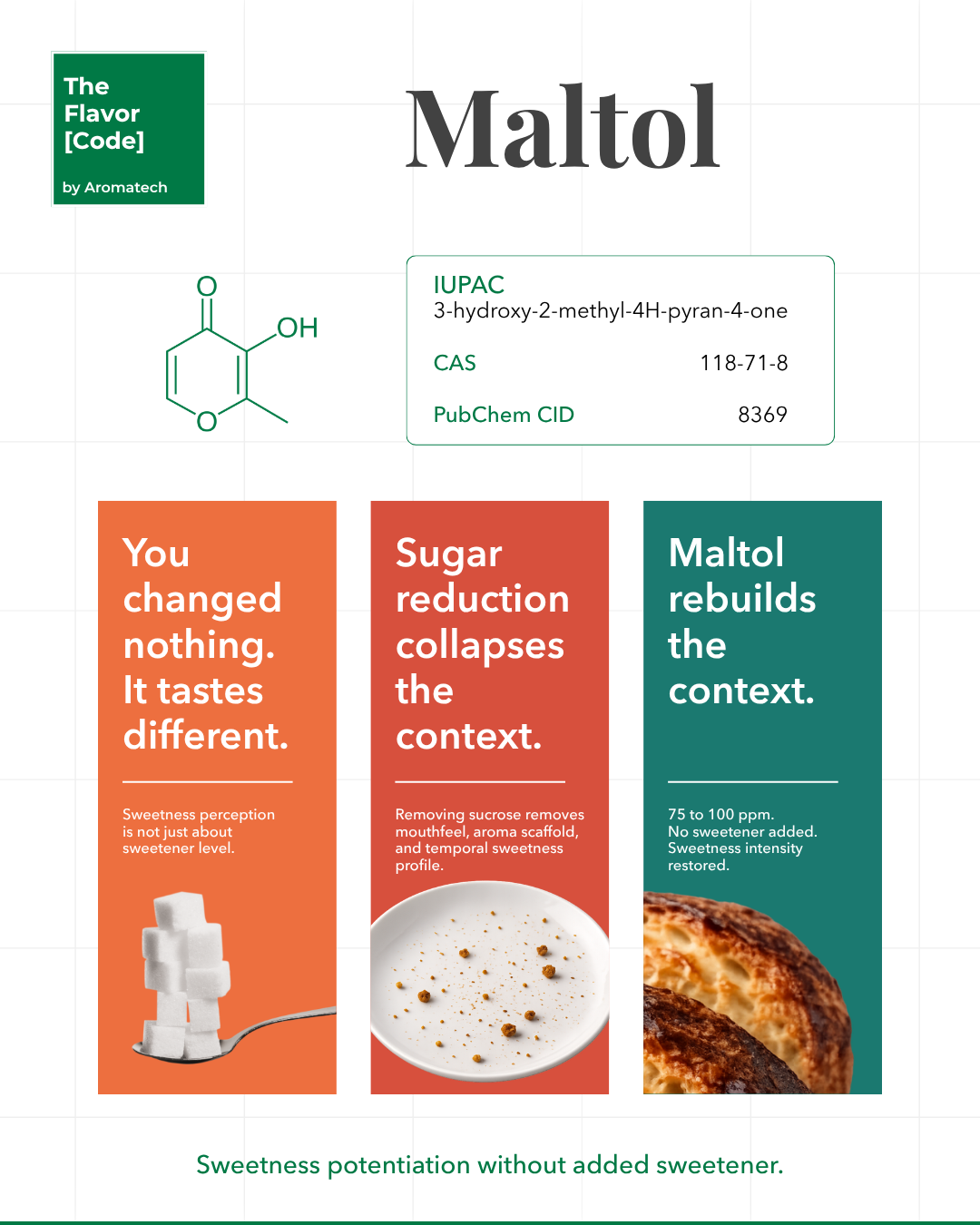
You cut sugar by 15%. Consumer panels say it tastes like you cut it by 30%.
The math doesn’t add up, until you look at what was surrounding the sweetener.
Maltol appears naturally in caramelized bread crust, roasted barley, and cotton candy at concentrations under 5 ppm. At those trace levels, it reads as warm aroma: slightly caramelized, soft, faintly sweet. Most formulators encounter it in a flavor brief and move on.
But at 50 to 150 ppm, it does something entirely different.
Maltol doesn’t add sweetness. It amplifies the perceived intensity of the sucrose or high-intensity sweetener already in your matrix. The mechanism: it suppresses bitter side-notes common in reduced-sugar systems and smooths the temporal profile of sweetness, making the peak land faster and linger longer. The net result is a product that reads closer to its full-sugar benchmark, without any additional sweetener on the label.
The B2B pain is consistent. Sugar reduction projects underperform consumer expectations not because the sweetener is wrong, but because the context it lives in has changed. Removing 15% sucrose doesn’t just reduce sweetness by 15%. It collapses the mouthfeel cues and aroma scaffolding that make sweetness feel complete. Maltol rebuilds part of that structure.
Typical use rate: 50 to 150 ppm in beverages and confections. The optimal window tends to cluster around 75 to 100 ppm. Above 200 ppm, the caramelized character becomes dominant and reads as artificial. That narrow range is exactly the kind of variable that separates a reformulation that passes panels from one that doesn’t.
If you’re in a sugar reduction brief and sweetness intensity is underperforming, the answer usually isn’t more sweetener. It’s the context the sweetener sits in.