|
|
|
Your rose-lychee flavor was perfect on day one. By week three, it smelled like dish soap.
Most formulators blame the fragrance supplier. The real variable is the matrix.
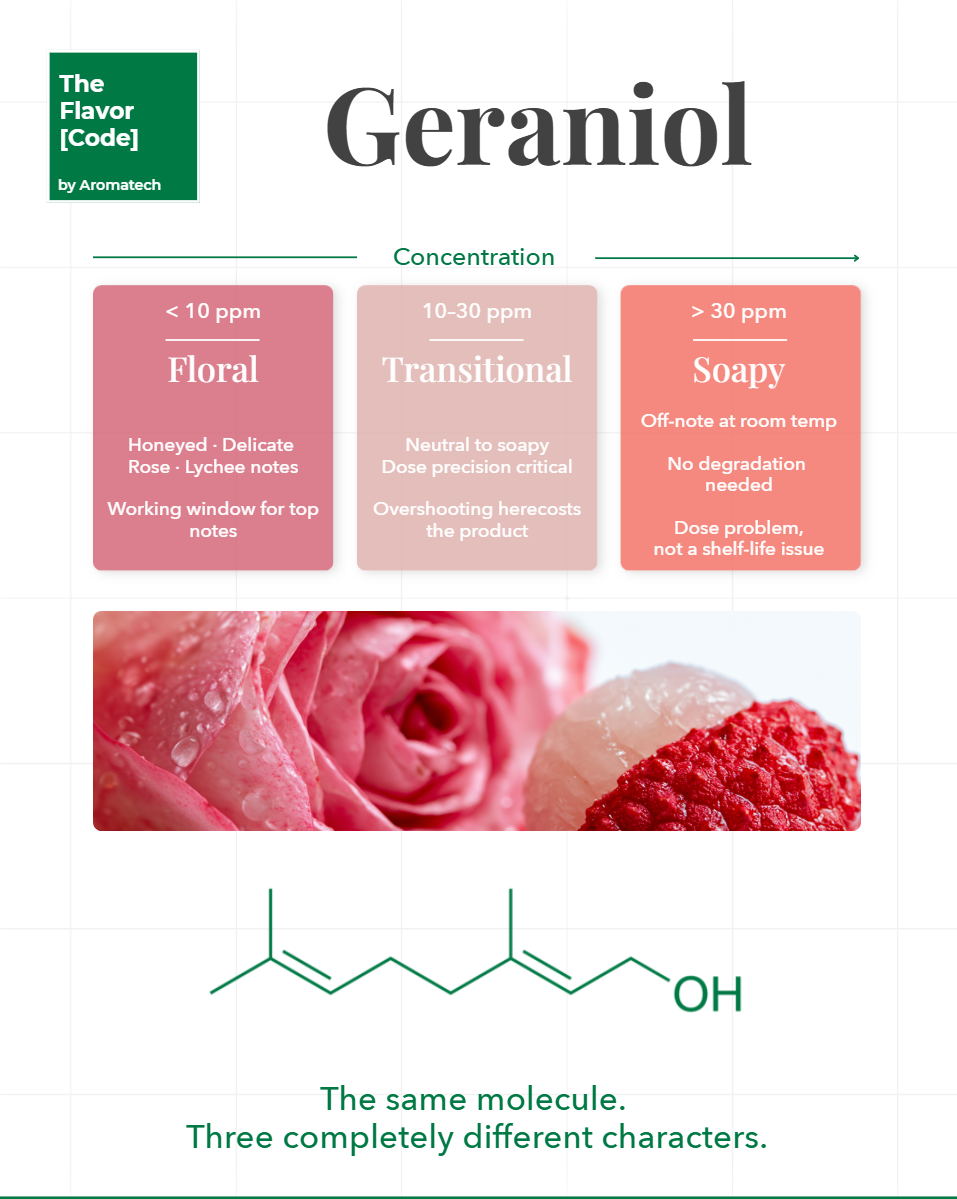
Geraniol is a terpenoid alcohol present in rose petals, citrus peel, lychee, and ginger. At concentrations below 10 ppm in aqueous systems, it reads floral, delicate, honeyed. That is the character you bought.
Above 30 ppm in the same water-based system, it reads soapy before any degradation has occurred. That is a dose problem, not a quality problem.
Then there is the stability question.
🌡️ Above 40°C and below pH 5.5, geraniol isomerizes to nerol, then degrades further to geranial and neral, the two aldehydes that constitute citral. Citral at low concentrations is harsh and soapy. That is not a vague drift. That is a documented chemical pathway with known temperature and pH thresholds.
🧪 In the presence of light and dissolved oxygen, geraniol oxidizes to citronellol and alpha-terpineol. Both push the profile toward synthetic and medicinal. Nitrogen blanketing during filling is not overcaution. It is the correct response to a known failure mode.
📐 The formulation window is narrow. Below 10 ppm for clean floral character. Above 30 ppm and the profile is already compromised at room temperature, before shelf life begins. The fix is not a new flavor. It is controlling the conditions that trigger the transformation.
Process temperature below 35°C. pH between 6.0 and 6.5.
Microencapsulation where warranted. Nitrogen blanketing at fill. These are not expensive interventions. They are basic matrix controls.
If your naturals-led top note is drifting, adjust the matrix before you touch the formula.