|
|
|
Every flavor has a code.
But sometimes the matrix writes its own code.
And it usually ruins the product.
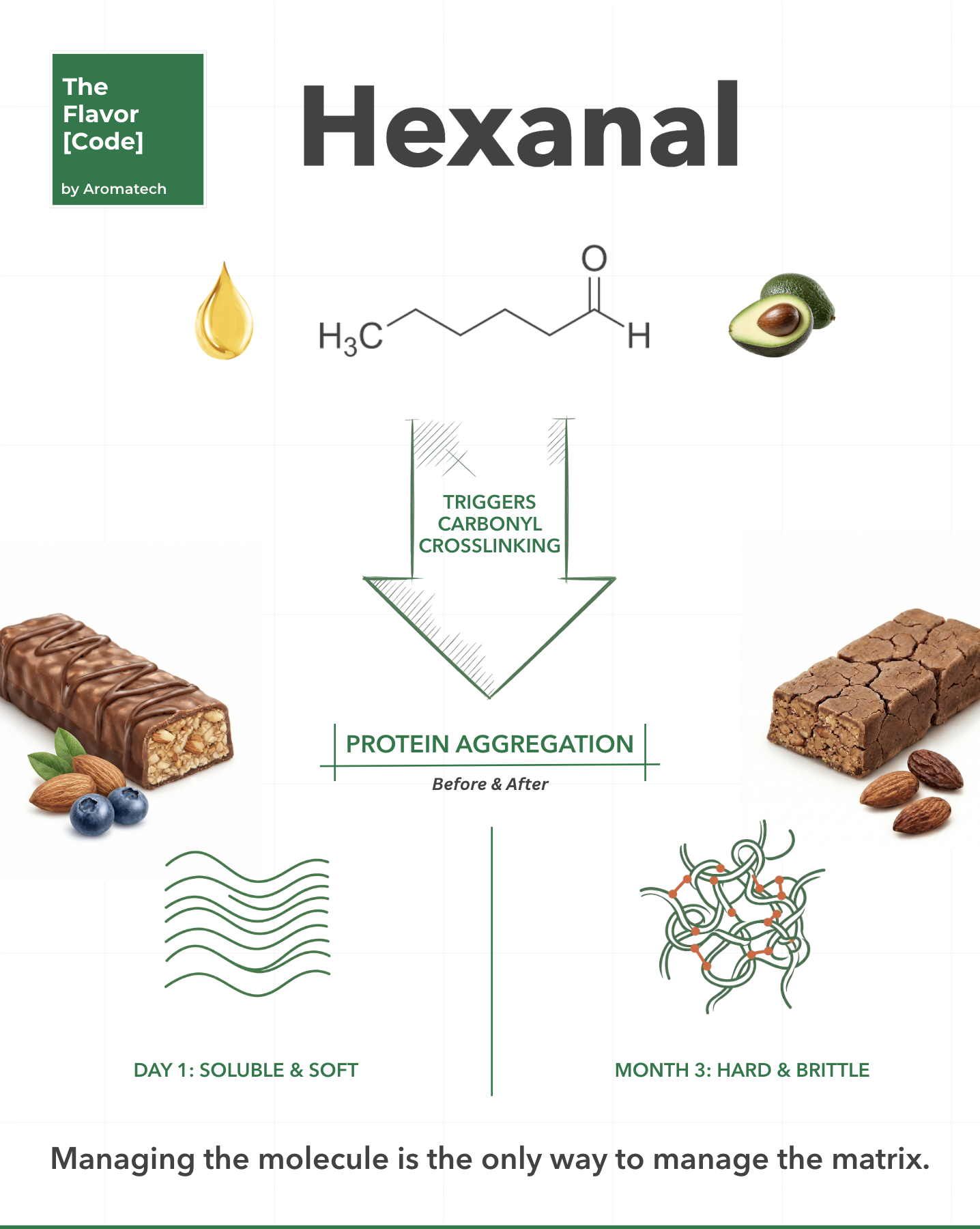
If you formulate with pea, lentil, or whey proteins, you know the beany or rancid off-notes. The primary molecule behind this is Hexanal.
You won’t find it on the ingredient list.
It forms naturally when fatty acids oxidize during storage and processing.
The instinct is usually to mask it with heavy flavors.
But masking only solves half the problem.
Because lipid oxidation products actually trigger protein oxidation.
This creates a destructive feedback loop.
It introduces carbonyl groups and causes your proteins to crosslink and aggregate. And that is exactly why your high-protein bars turn into literal bricks on the shelf.
Moisture migration and this lipid-protein oxidation loop are directly correlated with bar hardening. You cannot flavor your way out of oxidation. You have to manage the matrix to stop the chemical cascade.
🧪 Target the extraction: Non-thermal physical treatments like using synthetic resins (like Amberlite XAD16N) can physically adsorb and reduce hexanal in lentil isolates by up to 52%.
🌾 Switch the protein base: Rice protein lacks the highly reactive amino acids found in whey, making it way less susceptible to the oxidation-driven aggregation that causes physical hardening.
🛡️ Deploy antioxidants early: Adding antioxidants reduces the initial protein oxidation, slowing down the crosslinking that leads to phase separation and hardening.
Protecting your product means understanding what goes wrong at the molecular level.