|
|
|
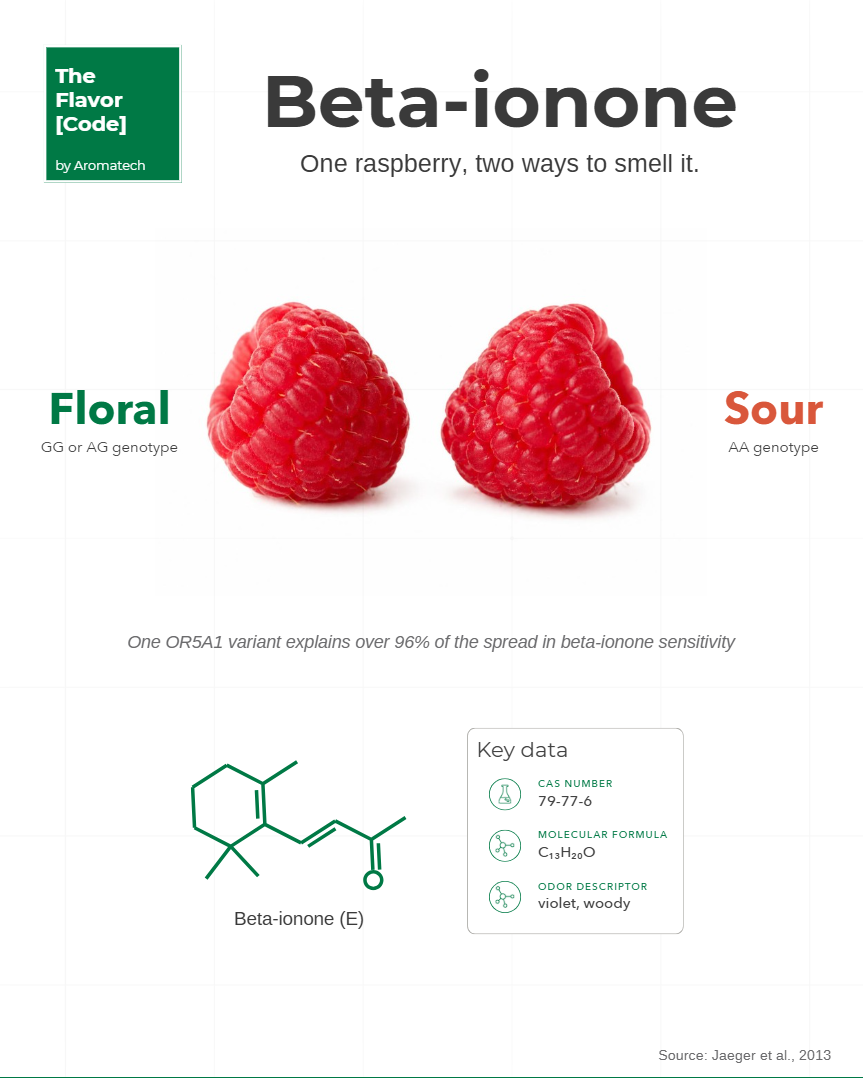
Two people can taste the same raspberry juice and describe two different drinks.
One gets violets. The other gets something sour, soapy, a little chemical. Both had the same sample at the same dose, and the difference sits in one receptor gene.
The molecule is beta-ionone. With raspberry ketone and alpha-ionone, it ranked among the most important aroma compounds in ten raspberry varieties (Larsen et al., 1991), and it is the classic violet note.
A single variant in the OR5A1 odor receptor gene explains over 96% of the spread in how sensitive people are to beta-ionone (Jaeger et al., 2013). Sensitive tasters call it floral. Less sensitive ones describe it as sour or pungent and like it less.
The effect holds in real products. In raspberry, apple and orange juices and jellies, the dose needed to read as floral or violet differed between the two genotype groups (Jaeger et al., 2014).
A fair objection is that raspberry is more than one molecule, and the 2014 study did see fruity notes mask beta-ionone. Masking softens the gap, but a panel judging the floral lift of a raspberry or violet profile is still judging the one note part of the room perceives differently.
So when a raspberry or violet match comes back “too weak” or “a bit soapy”, check who tasted it before you touch the spec. A short beta-ionone screen of your panel turns the taster into a known variable.
Explore our flavor catalogue: https://aromatech-portfolio.vercel.app/index.html