|
|
|
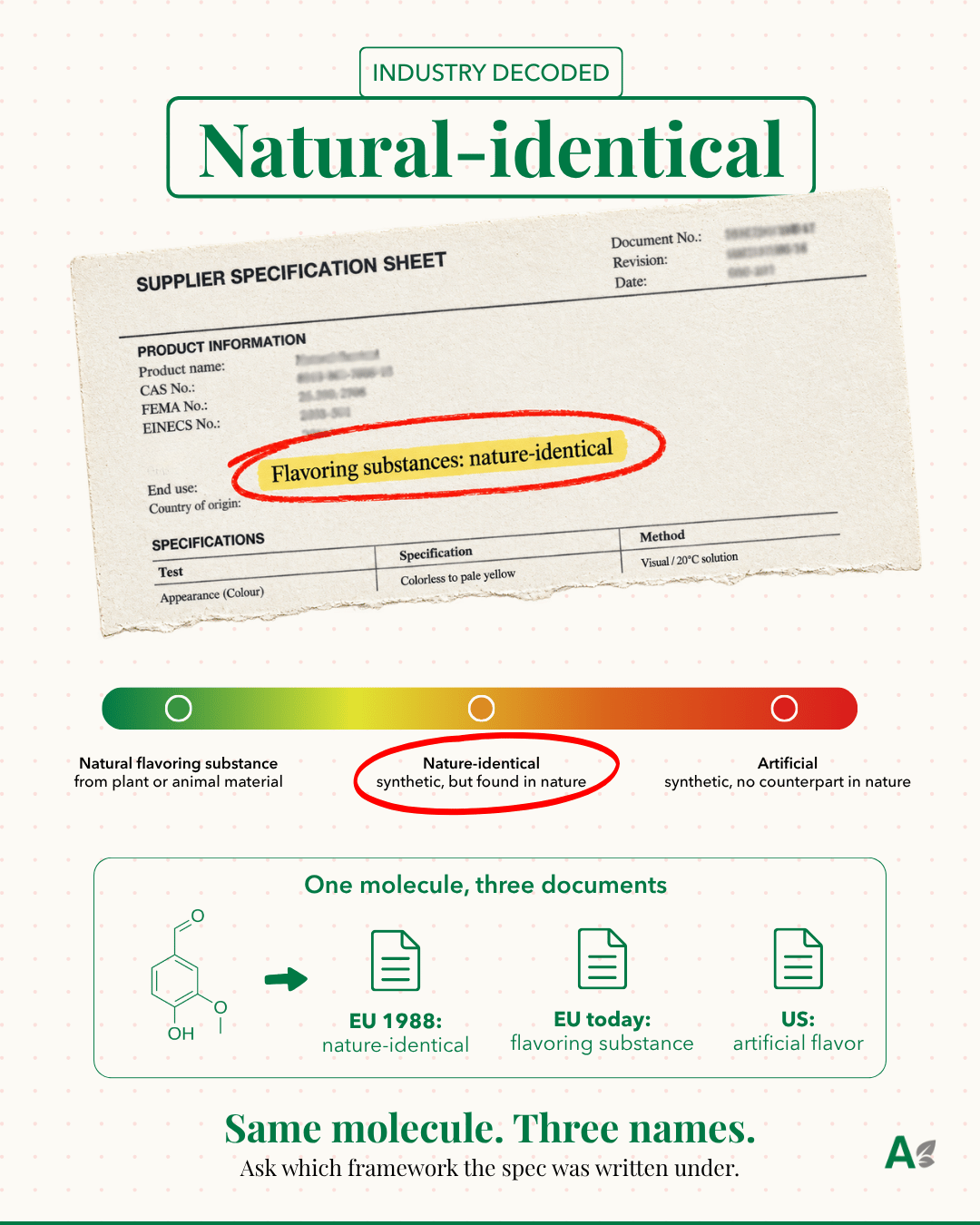
“Nature-identical.” It’s on the regulatory line of a European spec sheet somewhere in your supplier folder. Most people move past it.
A nature-identical flavor molecule is made by chemical synthesis and is the same molecule you would find in nature. Synthetic vanillin is the obvious one. Same molecule the vanilla bean makes, built in a reactor instead of a pod.
The word comes from a ladder the EU wrote in 1988, in Council Directive 88/388/EEC. A natural flavoring substance is obtained by physical, enzymatic or microbiological processes from plant or animal material. A nature-identical substance is made by chemical synthesis but is identical to a molecule found in nature. An artificial substance is made by chemical synthesis and has no counterpart in nature.
Then the EU deleted the middle rung. Regulation (EC) 1334/2008 has applied since 20 January 2011. It keeps “natural flavoring substance” and puts everything else in one bucket called “flavoring substance.” Nature-identical no longer exists in EU law. Brussels stopped caring whether nature also makes a synthetic molecule. The only claim it still polices is “natural,” and Article 16 guards that with a 95 percent from-the-named-source rule.
We think that was the right call, and we also understand why the word refuses to die. India’s FSSAI still runs the three tiers and published a clarification on nature-identical flavors in spirits in August 2026. Supplier documents written before 2011 still carry it. Some written last year do too, out of habit. And the habit has a reason. Nature-identical tells a buyer the molecule already exists in food, which is a useful thing to know. It is not a label claim anywhere you sell, though.
The US never had the word at all. 21 CFR 101.22 has two categories, natural and artificial, defined by source. Synthetic vanillin, nature-identical in old European paperwork, is “artificial flavor” on an American label.
One molecule, three names, depending on which document you are holding. If a spec says nature-identical, ask which framework it was written under before you build a label on it. On a US label, that line reads artificial.
Explore our flavor catalogue: https://aromatech-portfolio.vercel.app/index.html