|
|
|
Half the world tastes candy here. The other half tastes a muscle rub.
Wintergreen gum, root beer, birch beer. In the US this reads sweet, cold and nostalgic. Put the same sample in front of a European panel and you get liniment, hospital, medicine. Neither panel is wrong. The molecule genuinely is a drug.
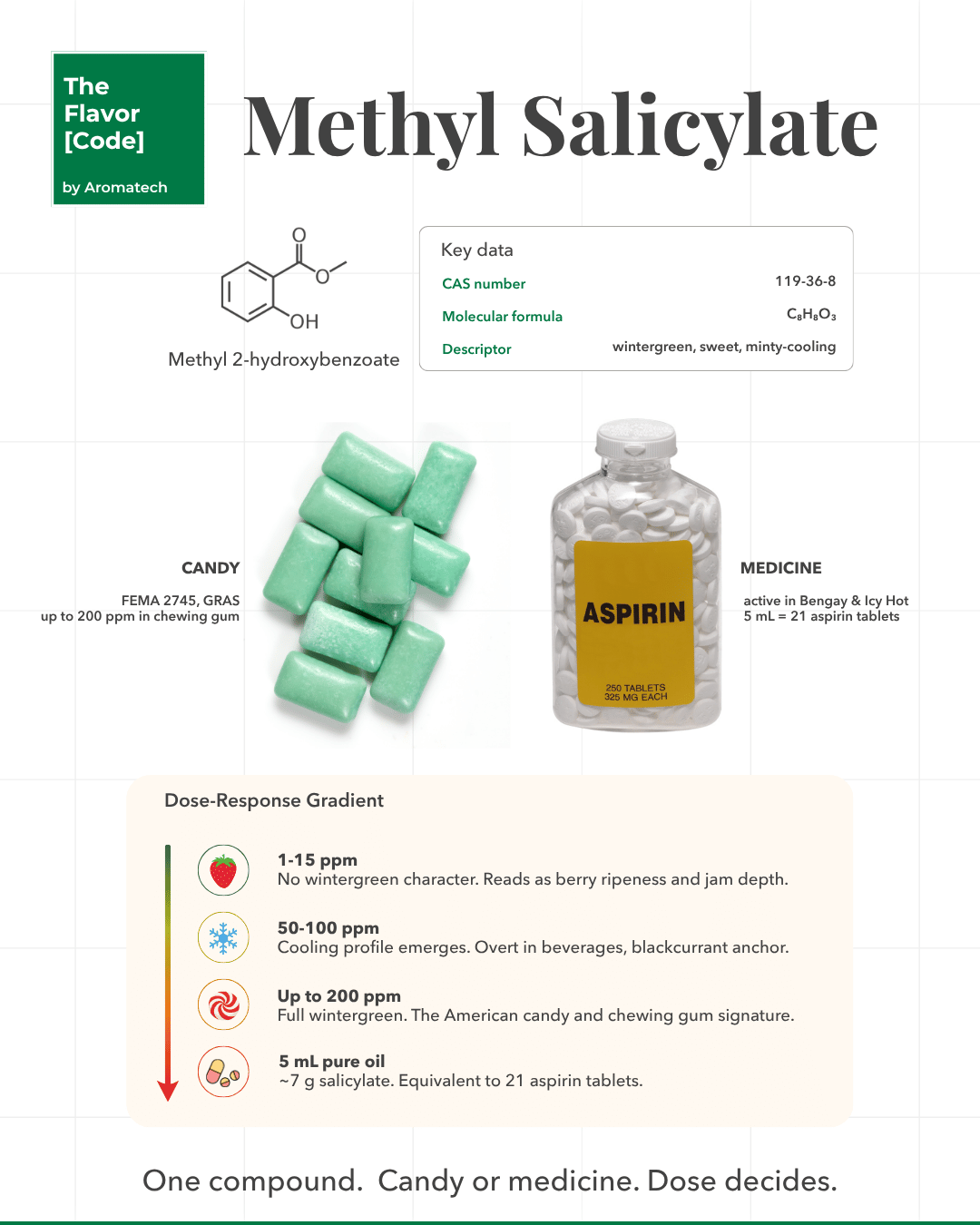
Methyl salicylate is the methyl ester of salicylic acid. The active compound in Bengay and Icy Hot, and FEMA 2745 in your candy brief. One compound, two industries, separated by dose.
At 1 to 15 ppm, it sits in the normal working range with no wintergreen character at all. On berry profiles it reads as ripeness and jam. Push to 50 to 100 ppm in beverages and the profile turns cooling and overt. At up to 200 ppm in chewing gum, you get full wintergreen, the American candy signature. But 5 mL of pure oil carries roughly 7 g of salicylate, about 21 aspirin tablets.
That last line is why this molecule draws more scrutiny than its flavor profile suggests. JECFA and EFSA both set an ADI of 0.5 mg/kg bw. Estimated consumer intake sits near 0.1 mg/kg bw. Nobody is formulating anywhere near the limit in gum or soda.
The real question is geography, not toxicology. The EU restricts methyl salicylate in cosmetics for children under six. The US has no comparable limit. When a molecule’s file is open in one market and closed in another, that gap tends to close in one direction.
If your brief says wintergreen, the market your consumer is in matters as much as the dose.
Explore our flavor catalogue: https://aromatech-portfolio.vercel.app/index.html