|
|
|
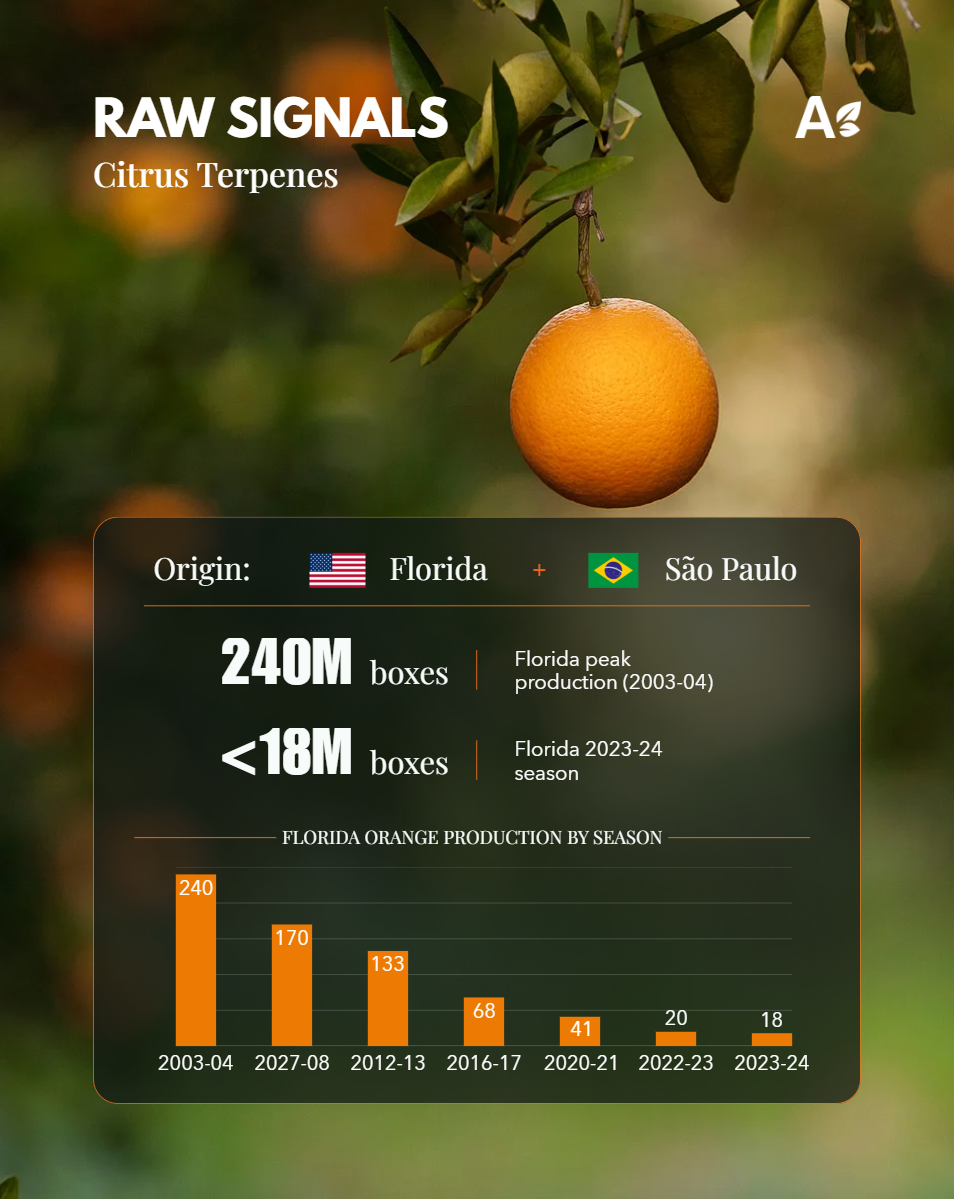
Florida produced 240 million boxes of oranges in 2003. Last season: under 18 million. If you’re not watching OJ crop reports, you’re not watching your citrus terpene supply.
D-limonene, the dominant terpene in virtually every citrus flavor profile, is not grown. It is extracted from orange peel as a byproduct of juice processing. Which means the moment OJ production contracts, the available pool of citrus terpenes contracts with it. And Florida’s OJ production has been in near-freefall for over a decade.
Florida once produced over 240 million boxes of oranges in a single season. By 2023-24, that number had fallen below 18 million, a collapse driven by Huanglongbing (citrus greening disease), Hurricane Ian’s direct hit on Southwest Florida’s groves in September 2022, and a sustained consumer shift away from juice. Brazil’s Sao Paulo belt absorbs some of that slack, but Sao Paulo has its own weather dependency: drought events across the interior and periodic frost exposure that can knock out an entire flowering cycle in a single night.
The risk mechanism here is structural, not seasonal. Terpenes do not have a dedicated crop. When OJ production shrinks, whether from disease pressure, storm damage, or demand decline, peel availability shrinks in lockstep. You cannot replant a terpene harvest. You can only capture what the juice industry yields. And right now, the juice industry is yielding less every year.
For product developers, this has two downstream implications. First, d-limonene price pressure is not cyclical in the traditional sense, it does not resolve when a bad harvest year ends. It tracks the structural decline of a host industry. Second, the quality and consistency of cold-pressed citrus oils fluctuates with seasonal peel maturity, meaning the profile you validated in Q1 may not match what ships in Q3 if sourcing has shifted.
The formulation pathways around this are not impossible, but they involve trade-offs. Folded orange oils concentrate the active fraction and can extend coverage when peel oil is in short supply. Terpeneless extracts remove d-limonene almost entirely, improving stability and water-solubility but sacrificing the fresh, bright top note most developers associate with natural citrus character. Reconstituted profiles built on isolated terpene fractions give you more specification control, but require a sourcing partner with enough supply depth to maintain batch-to-batch consistency.