|
|
|
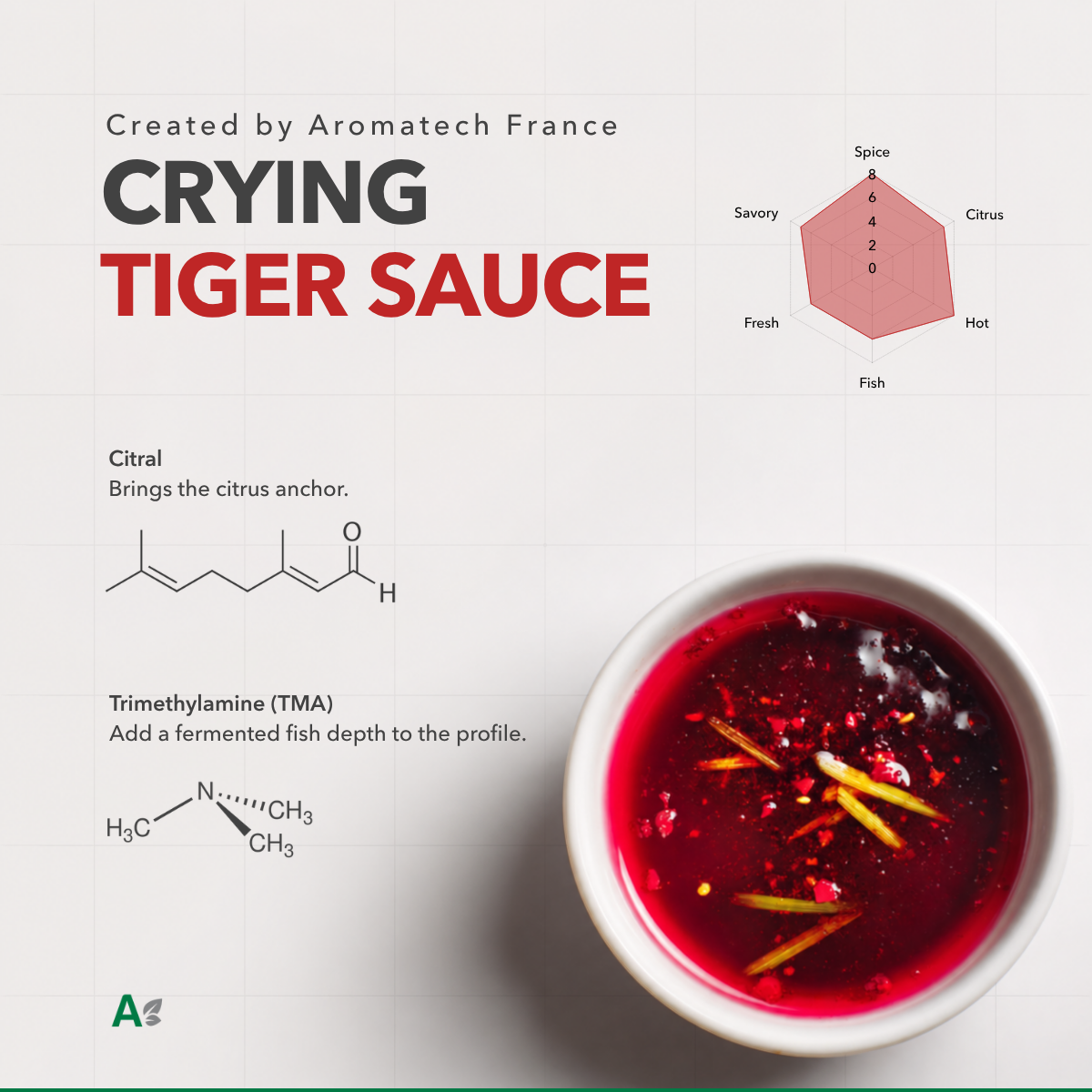
A tiger would cry if it couldn’t eat this.
That is the literal legend behind Suea Rong Hai, the Crying Tiger Sauce, a dipping sauce born in the Isan region of northeastern Thailand, built around grilled beef and a profile that runs in six directions at once: spicy, savory, citrus, hot, fish, and fresh.
Keeping all six pulling together without any one of them taking over is the real formulation brief.
Two molecules do a lot of the work here:
🍋 Citral is the geranial/neral blend driving lime and lemongrass character, anchors the citrus top note.
The challenge: it is an α,β-unsaturated aldehyde, reactive with the amine compounds that come with any fish-forward matrix. Without management, the bright citrus note fades before the product reaches its application.
🐟 Trimethylamine (TMA) is what fish sauce actually smells like at the molecular level, produced via microbial TMAO reduction during fermentation. At the right dose and pH it reads as savory depth. Off that window and it becomes a defect.
The added complexity: TMA’s amine group and citral’s aldehyde interact directly, making their co-stability something to design around.
Natural. Allergen-free. Kosher. Vegan.
Built for marinades, broths, spring rolls, and dumplings.