Logo Aromatech
| | |

Aromatech the Archive

Création Visuel pour le post :How Citral Degrades in Beverages

How Citral Degrades in Beverages

13 Oct 2026
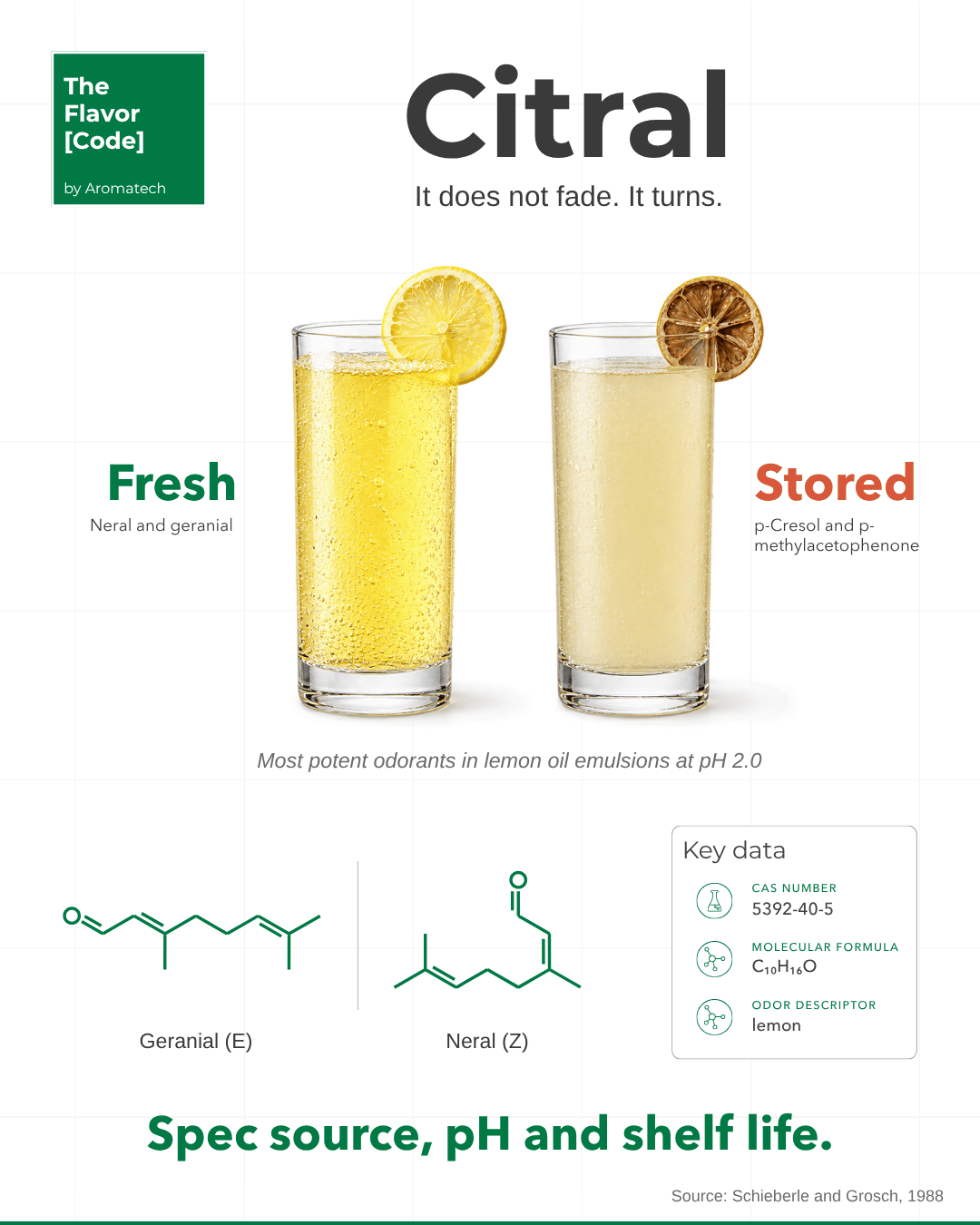
Your lemon soda does not lose its lemon on the shelf. It turns it into something worse. The bright lemon note in a soda or an iced tea comes mostly from citral, an aldehyde made of two isomers, neral and ...

Read more
Création Visuel pour le post :What no artificial flavors excludes

What no artificial flavors excludes

09 Oct 2026
The ingredient that keeps landing this label claim in court is not a flavor. It is malic acid. "No artificial flavors." Next time that line shows up on a front panel or a supplier spec, it helps to know how ...

Read more
Création Visuel pour le post :Carvone enantiomers in flavor specifications

Carvone enantiomers in flavor specifications

07 Oct 2026
Spearmint gum and rye bread taste nothing alike. Their signature aroma comes from the same molecule, in mirror image. That molecule is carvone. Same atoms, same bonds. Only the 3D layout around one carbon differs, the way a left hand ...

Read more
Création Visuel pour le post :Haskap Flavor Chemistry Explained

Haskap Flavor Chemistry Explained

05 Oct 2026
A berry prized for jam in Hokkaido shares one of its key aroma molecules with eucalyptus. Haskap, the blue honeysuckle berry, is native to the cold regions of the Northern Hemisphere. It is emblematic of Hokkaido and also grows in ...

Read more
Création Visuel pour le post :Four ways bitterness masking works

Four ways bitterness masking works

02 Oct 2026
A lot of what is sold as bitterness masking does not block bitterness. It adds sweetness under a technical name. "Natural Flavor, bitterness masking." Next time that line shows up on a spec, taste the ingredient alone in plain water, ...

Read more
Création Visuel pour le post :Odor Thresholds Depend on the Test

Odor Thresholds Depend on the Test

29 Sep 2026
One off note, one Sauvignon blanc, two published detection thresholds: 17.4 and 210 parts per trillion (ng/L). The only thing that changed was the panel. The molecule is TCA, the compound behind cork taint. It shows that a published threshold ...

Read more