|
|
|
The same vanilla flavor can clear one grocer’s ingredient review and get turned away by the next, without a single change to the formula.
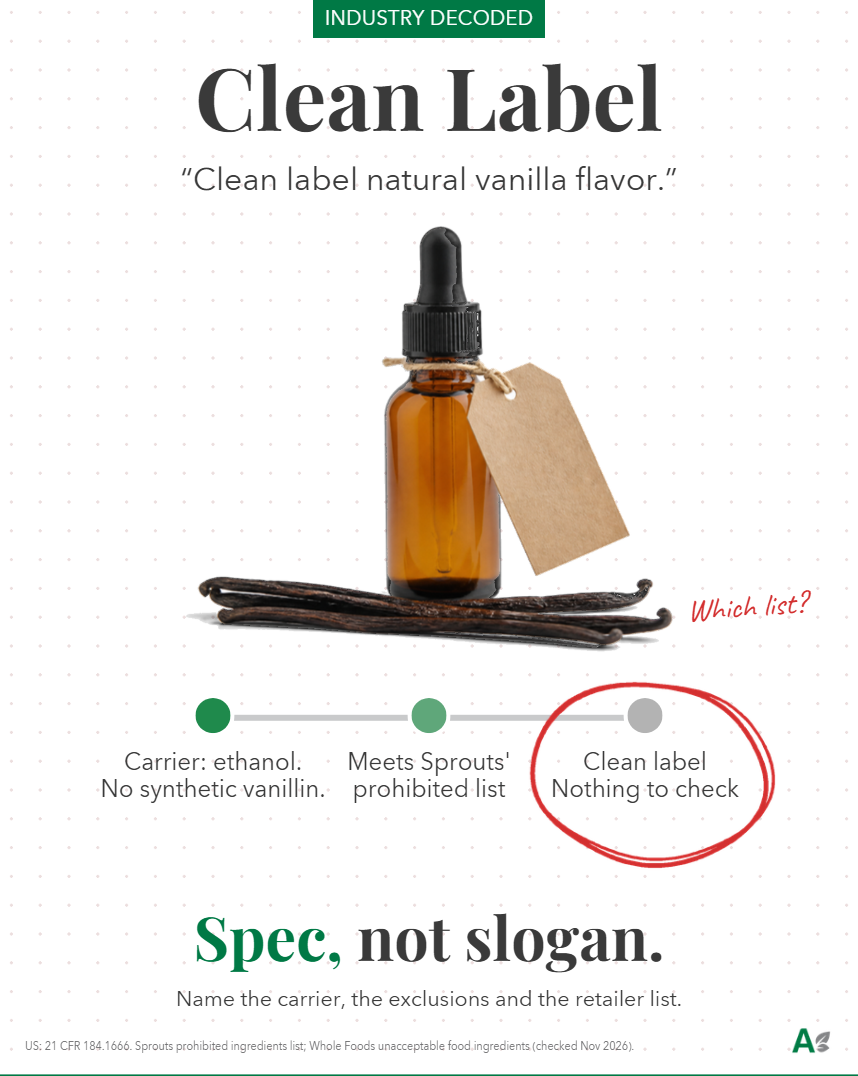
“Clean label natural vanilla flavor.” That line on a supplier spec has no legal definition behind it, in the US or in the EU.
Clean label is a marketing position: an ingredient statement that reads short and familiar. No agency defines it, so there is nothing to test a sample against and nothing a contract can hold a supplier to.
A spec can describe that same vanilla in three ways, from strongest to weakest. “Carrier: ethanol. No synthetic vanillin.” can be checked line by line. “Meets Sprouts’ prohibited list” puts one retailer’s exclusions in writing. “Clean label” puts nothing in writing, so there is nothing to check.
Retailers filled the gap with their own lists, and those lists disagree. Sprouts’ prohibited ingredients list names propylene glycol, one of the most common carriers in liquid flavors. Whole Foods’ list of unacceptable food ingredients does not. FDA affirms propylene glycol as GRAS (21 CFR 184.1666). One vanilla flavor in propylene glycol can be GRAS, absent from one chain’s list and prohibited by another.
The fair objection is that retailer lists are the working definition, and for a brand selling into a single chain that holds. It closes only part of the gap. The lists differ from chain to chain and get revised, and a flavor spec that says clean label rarely says which list it means.
Before you accept clean label on a flavor spec, replace it with three written lines: the carrier by name, the excluded ingredients by name, and the retailer list the flavor has to meet.
Explore our flavor catalogue: https://aromatech-portfolio.vercel.app/index.html