|
|
|
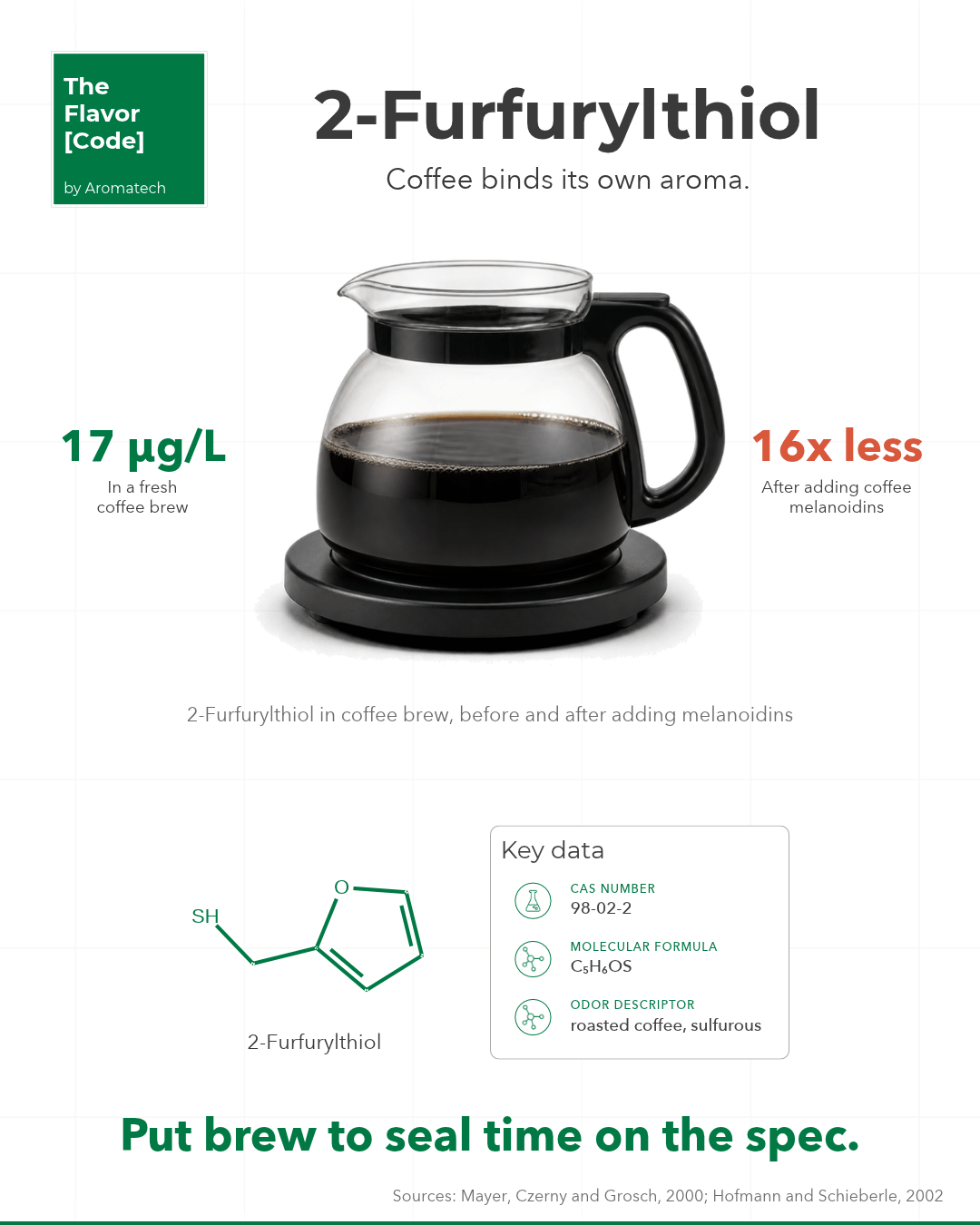
Coffee kept on the warmer stops smelling fresh long before anyone pours the last cup. Most of that roasty aroma is still in the pot, bound to the coffee itself.
The smell of fresh brew comes largely from 2-furfurylthiol, a small sulfur compound. Concentrated, it smells sulfurous and burnt. Diluted, it smells like coffee.
A fresh brew holds about 17 µg/L of it, more than 1,000 times its odor threshold in water (Mayer, Czerny and Grosch, 2000).
Melanoidins, the brown polymers formed during roasting, trap thiols. Added to a fresh brew, they cut its 2-furfurylthiol by a factor of 16 (Hofmann and Schieberle, 2002).
Time does the rest. In a model solution with coffee melanoidins, half of the 2-furfurylthiol had left the headspace after 20 minutes and almost all of it after 30, while the aldehydes beside it held steady (Hofmann et al., 2001).
Some aroma does evaporate, and heat speeds everything up. Evaporation would take the aldehydes too, though, and they stayed.
For RTD coffee, cold brew and coffee flavored drinks, this belongs on the spec. Brix, pH and caffeine say nothing about the molecule that makes it smell like fresh coffee. Write down the time from extraction to sealing, and score the roasty note itself at end of shelf life.
Explore our flavor catalogue: https://aromatech-portfolio.vercel.app/index.html