|
|
|
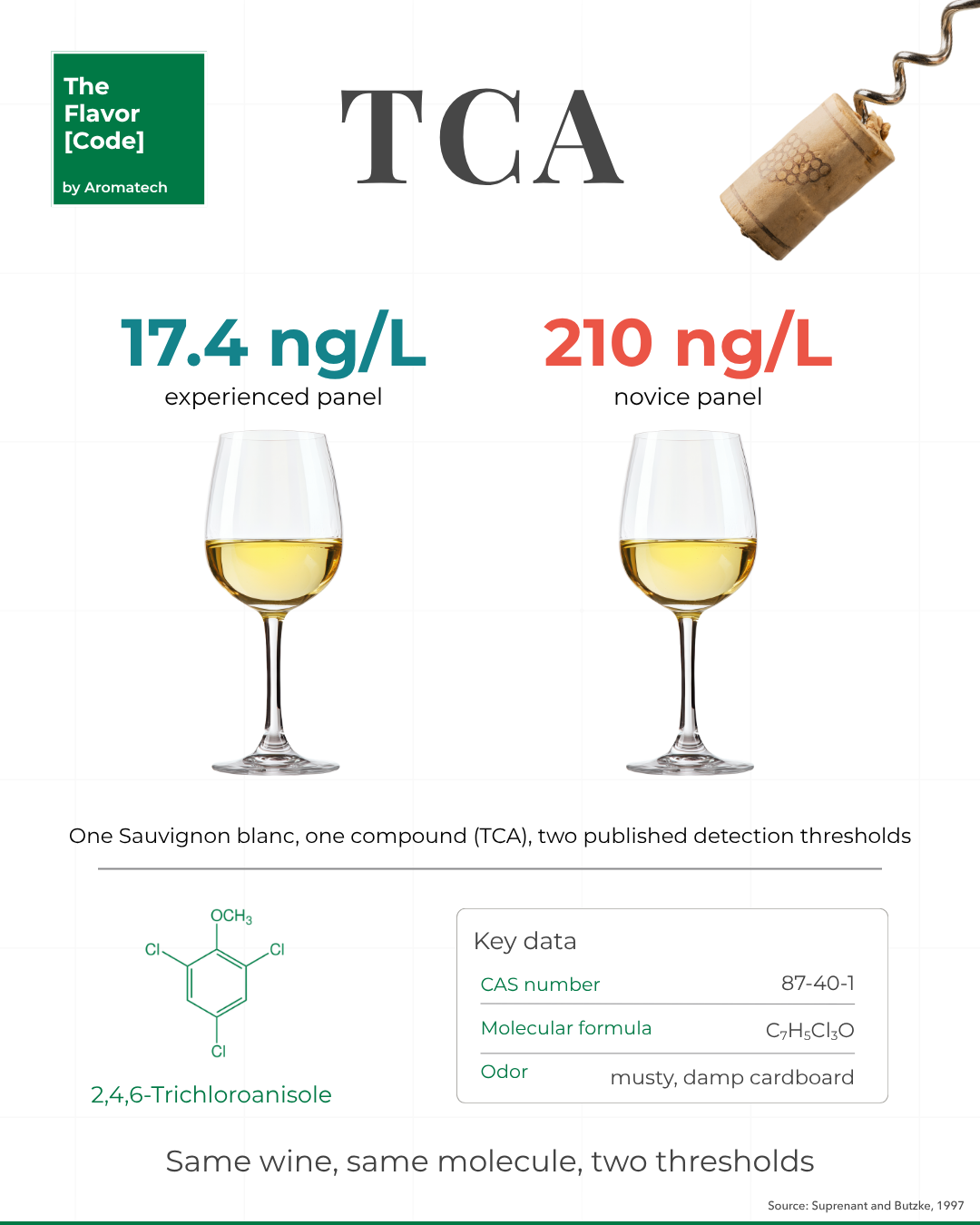
One off note, one Sauvignon blanc, two published detection thresholds: 17.4 and 210 parts per trillion (ng/L). The only thing that changed was the panel.
The molecule is TCA, the compound behind cork taint. It shows that a published threshold describes a test, not a molecule. We have quoted thresholds in this series as if they were use levels. That was a shortcut.
In water, trained panels report TCA anywhere from 0.03 to about 2 ng/L. Water has no alcohol, fat or aroma competing with it.
Across matrices, one trained panel identified it at 4.6 ng/L in water, 6.7 in white wine and 7.1 in red.
Below threshold, at 0.1 to 1 ng/L, TCA can already mute a wine’s own aroma before anyone can name it.
A fair objection is that thresholds still rank molecules by potency. Within one study, yes. Across studies, TCA alone spans more than three orders of magnitude. ASTM E679 itself warns that panel training shifts the result and that one presentation method does not reproduce another.
So measure the threshold in your finished product, with a panel that looks like your consumer, and state whether it is detection, recognition or rejection. A number without its matrix and method is not a spec.
Explore our flavor catalogue: https://aromatech-portfolio.vercel.app/index.html