|
|
|
The biggest ingredient in a liquid flavor is often not flavor. It sits on one line of the spec sheet, and most people read right past it: “Solvent: propylene glycol.”
A solvent is the liquid the flavor compounds are dissolved in. A carrier is the wider term for anything that dilutes or delivers them, like the maltodextrin base of a powder flavor. EU law files both under “carriers.” On a spec sheet they are separate lines, with separate consequences.
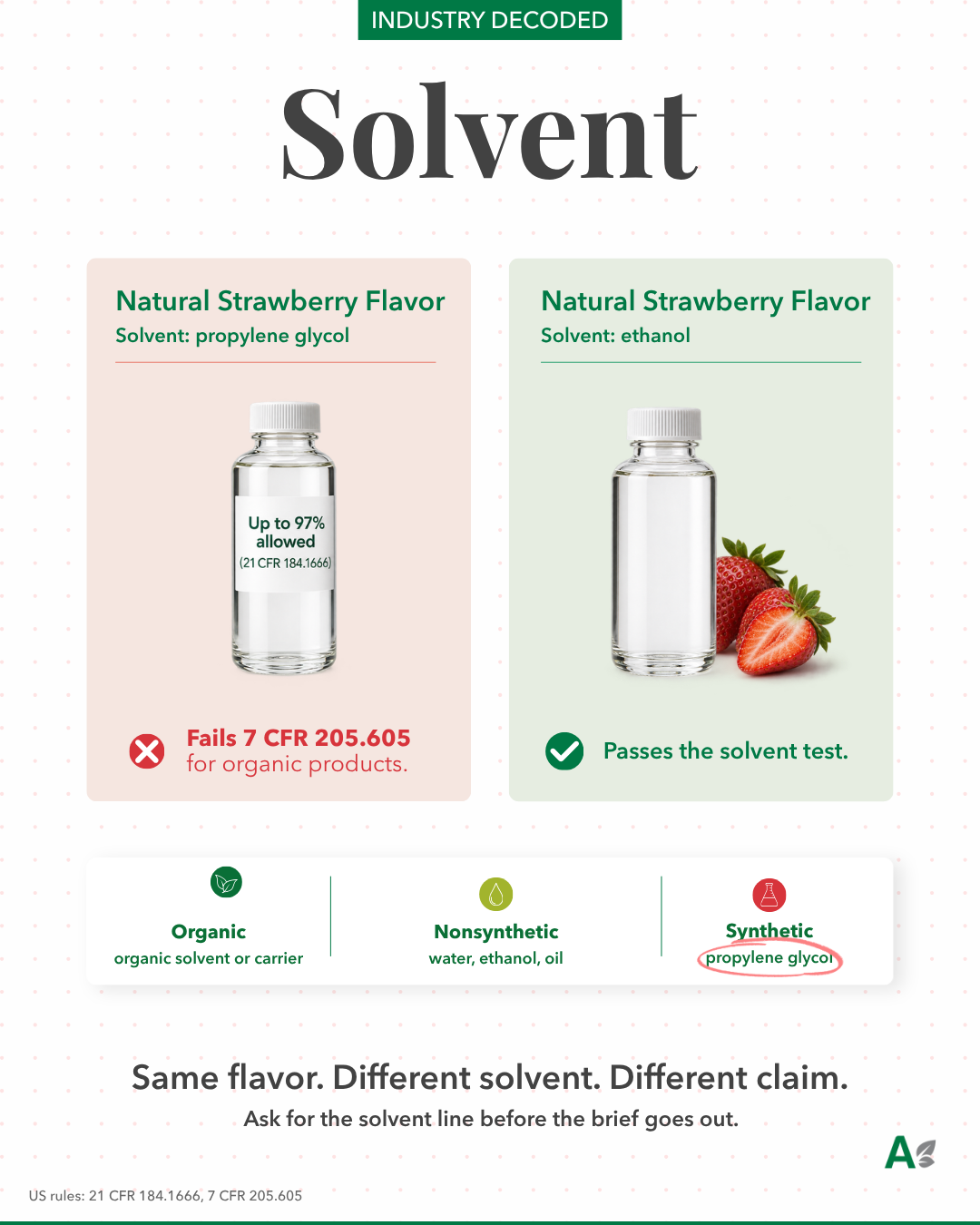
That solvent can be most of the bottle. 21 CFR 184.1666 permits propylene glycol at up to 97 percent in seasonings and flavorings, and the same section states that it “does not occur in nature.”
For claims on a US label, solvents and carriers fall into three groups. Certified organic ethanol, oil or carrier fits an organic flavor. Nonsynthetic options such as water, ethanol or vegetable oil are accepted when no organic flavor is available. Synthetic solvents such as propylene glycol, the most common solvent on a liquid spec, are barred from flavors used in organic products.
The rule behind that last group is 7 CFR 205.605. A product sold as organic can use a nonorganic flavor only if it is “not produced using synthetic solvents and carrier systems.” A natural flavor in propylene glycol fails that test, even when every flavor compound in it is natural.
And you will rarely see it. In the finished food, a flavor solvent typically counts as an incidental additive under 21 CFR 101.100(a)(3), present at an insignificant level with no function, so it stays off the ingredient statement. The detail that decides your claim is the one nobody reads.
The fair objection: propylene glycol is GRAS, inexpensive, and a workhorse in beverages and sauces. For a conventional product, keep it. Moving to ethanol or oil changes flammability, solubility and dose, and that costs real bench time.
Before an organic or clean label brief goes out, ask for the solvent and carrier lines, not just the flavor name.
Explore our flavor catalogue: https://aromatech-portfolio.vercel.app/index.html