|
|
|
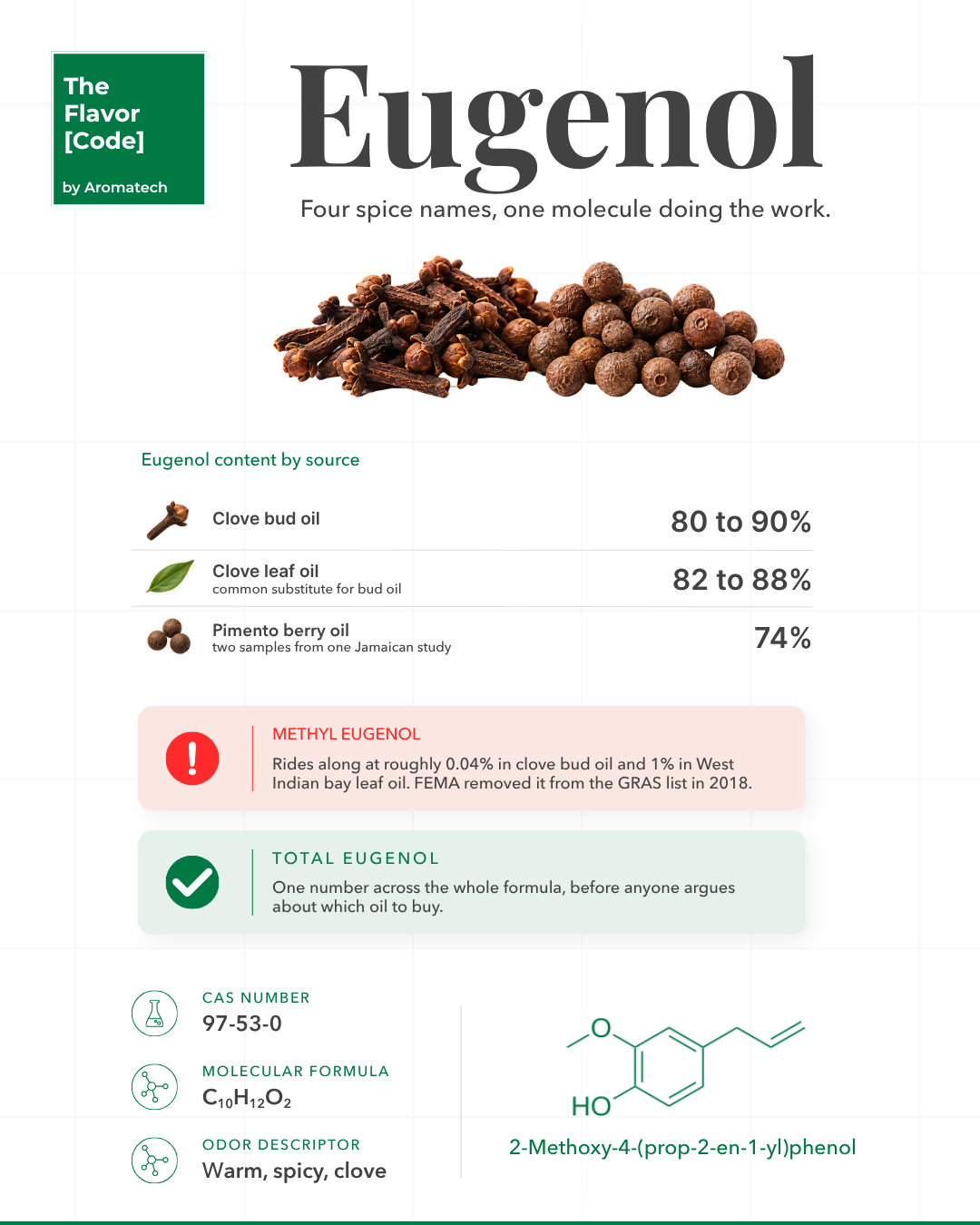
Clove and allspice are not two spices on your brief. Chemically they are mostly one compound, and nothing on the spec sheet will tell you that.
They are separate botanicals with separate CAS numbers. On the formula they are two line items. A formulator stacks both, adds West Indian bay on top, and never sees the overlap. The panel calls the result flat and medicinal, and nobody can say why.
The compound is eugenol. FEMA groups clove bud, clove leaf, clove stem, cinnamon leaf and West Indian bay leaf into one congeneric group because eugenol dominates every one of them. Allspice is assessed in a separate FEMA group, so nothing in the paperwork puts it next to clove.
Clove bud oil runs 80 to 90 percent eugenol. Clove leaf oil, the common substitute, is 82 to 88 percent. Two Jamaican pimento berry samples came in at 74.7 and 73.4 percent.
Methyl eugenol rides along at roughly 0.04 percent in clove bud oil and 1 percent in West Indian bay leaf oil. In those same two pimento samples it ran 4.1 and 9.5 percent. FEMA removed the isolated substance from the GRAS list in 2018 over DNA adduct formation. The spices that carry it naturally kept their status.
The oils are not interchangeable. Eugenyl acetate and the caryophyllene fraction are most of what separates clove from bay, and bay carries myrcene and chavicol that clove does not. Eugenol is the load, and the load stacks whether the brief accounts for it or not.
So total it. One eugenol number across the formula, before anyone argues about which oil to buy.
We would rather see that number on a brief than three botanical names.
Explore our flavor catalogue: https://aromatech-portfolio.vercel.app/index.html